Showing posts with label waste. Show all posts

Friday, July 2, 2010

Agrarian Road Trip: Part Three.

Coal Country, West Virginia.

Take Me Home, (Coal) Country Roads:

the Agrarian Tour through West Virginia

One of the unofficial theme songs for us – Agrarian Road Trippers – has been John Denver’s “Country Roads” – mainly because of the line “West Virginia. Mountain Mama. Take me home. Country Roads.” And West Virginia – or at least the southwest region – has her fair share of country roads. It is in the midst of these country roads that we have visited and shared stories – as well as a few bluegrass tunes, picked out on banjo and guitar – with fellow agrarian minded folks in Coal Country, West Virginia.

Day Six and Day Seven:

Mullens Community Garden at RAIL.

Our main contact in Mullens, West Virginia, is the organization Rural Appalachian Improvement League (RAIL), where we hook up with fellow young agrarians Jack and Becky. Jack has been working with RAIL since 2008. Originally from West Virginia, Jack was hired to start a farmers market in Mullens – only problem being there were no farmers. This is coal country. No one farms here. In order to tell his story of the work he has done with RAIL, Jack first had to share the story of coal in Mullens and her surrounding coal camps.

the Locals.

First off, there aren’t towns. There are coal camps – little “villages” created by the coal companies to house miners. These houses were built precariously upon steep mountain hillsides, with little space betwixt neighboring houses – seldom a yard or septic tank. Today, 65% of all sewage in Wyoming county is directly pumped into the river running through the camps. This is not to mention the additional run-off dumped by the coal industry. This is the water – should agriculture gain momentum – that will be used to irrigate gardens and livestock. In 2001, Mullens suffered a drastic flood, water climbing to ceilings on the first floor story of buildings and homes throughout the town. Although a flood to this magnitude is not common, seasonal flooding happens on a regular basis. For the beginning agrarian, having your garden washed away at least once per season is quite the discouraging start.
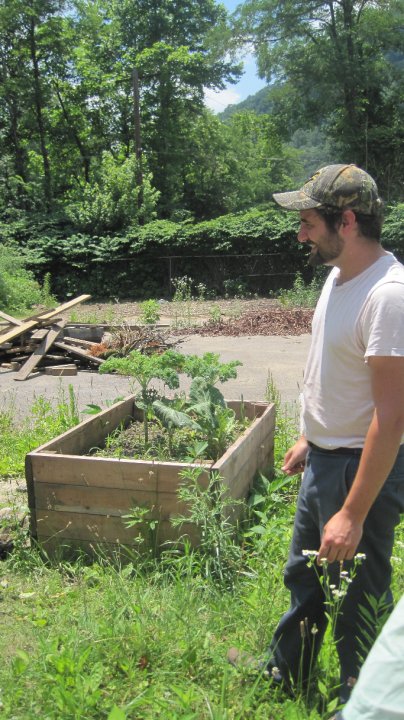
Farmer Jack at the Mullens Community Gardens.

However, Jack sees gardening as one step towards self-sufficiency for the people living in communities historically tied to the coal industry. In former times, the coal companies outlawed gardening in coal camps – thus making coal miners and their families dependent on purchasing food from the mercantile stores operated by the coal companies. Although growing gardens is no longer illegal, the coal companies still own 85% of the land in Wyoming county where Mullens is seated. Another 5% of the land is owned by state and federal government – leaving a mere 10% of land available to the people for housing, parks, gardens and businesses.

Visting a neighboring gardener and his horse Hank.

Coal is in the blood of the people,” one local woman from the organization, Friends of Milam Creek, told us. Out of the 20,000 people in Wyoming County, only 800 are employed in the coal industry. Employment in coal has drastically decrease with the rise in mechanization of the industry. Although most people living in coal country know at least one person who has died of black lung, jobs in the coal industry are the most sought-after. A coal miner with a high school education can make more money in a year than a college professor with a PhD. The balance of health-versus-wealth is a thin line to walk in the coal industry. Jobs for the remaining individuals span mechanical labor, food service and retail. Many area youth drift away from their communities when – and if – the opportunity arises.

Note: bumper sticker.

With all these thoughts muddling up my mind, we head out to the RAIL Community Garden – to mull over thoughts and pull some weeds. In addition to locating spaces for community residents to “farm” – there is a stigma attached to the lesser work of gardening – RAIL provides workshops on growing food, canning and preserving, and hosts a farmers market on RAIL’s property. Fresh food is grown for sale at market, for donation to food pantries, and for family consumption of those who grow it. We visited a few more gardens before harvesting some vegetables for our own dinner. At our last stop I noticed two bumper stickers both at the same house: “Nader/Gonzalez” and “I ‘heart’ Coal” – an interesting combination rarely replicated in any other community.

Note: political sign.

It doesn’t take an agrarian-minded person to connect the story of coal country economics in Appalachia to mechanized, mono-cropped agriculture in the Midwest. (The average age of a farmer in America today is 57.) Disillusioned youth are encouraged to seek educational opportunities elsewhere due to the lack of vocational attachment to the industry of the area. To leave is to succeed. Rarely applauded or honored are those who choose to stay. To mine. To farm. Outside do-gooders with liberal arts educations grounded in service to community are heralded by their own communities as heroes. But those who choose to stay are seen as having missed their golden opportunity.

West Virginia, Mountain Mama. Country roads, take me home.

End Day Seven. End Part Three.

Saturday, August 2, 2008

King of the (Sawdust) Mountain

Recommended Reading:
Here Today, Gone Tomorrow: The Hidden Life of Trash,
by Heather Rogers
http://www.gonetomorrow.org/

Compost Toilet
: A toilet system which treats human waste by composting. A bulking agent (in our case-sawdust) is added to the waste after each use to consolidate the waste and aid the composting process. After many months, the sawdusted waste can be shoveled out and finished in the sun. This end-product can be a soil-additive rich in beneficial bacteria. As opposed to expensive, water-wasting plumbing systems and waste-treatment centers, composting human waste can be a beneficial, responsible, yet smelly way, to handle waste.

Anecdote: The farm employs the hardy services of four composting toilets; a bin of some sort sits next to each toilet filled with sawdust as the bulking agent. In the girl's dorm, we have a small trash can that must be refilled with sawdust every few days or so. In the Education Building, the box can go for a week or two before needing to be refilled. Who's job is the sawdust refilling? That depends: in the dorm, whoever scoops the last dust has the responsibility. In the ed. building, no one really knows: a volunteer from town? a chore? an apartment dweller? the pregnant office manager?

We have eight giant barrels filled with sawdust on porches. Refilling trash cans and large boxes should be as easy as scooping form the big barrel. Last Thursday, after dorm and ed. building sawdust containers had been empty for about two days, we finally figured out together that there was no sawdust in the barrels. It is tricky. Each person thinks someone else is taking care of the empty bins because the job never gets assigned to just one person. The stench of each toilet finally became too nose-scrunching.

Friday after lunch, W-J-D-R-and myself loaded all eight barrels into the farm truck and trailer and headed north to the Pallet place. On the side of I-35, there is this barn-type building with wooden pallets stacked inside and all around. A few mechanized contraptions whiz and whir, but nothing was actually being done. What exactly does the Pallet place do? Recycle old pallets? Store old pallets? Resell old pallets? Make new pallets? Nobody knows.

We drove across grass and weeds, around the side of the building, nobody giving us a second glance, and parked next to a giant mound of sawdust. Assembly-line style, we pitchforked sawdust clumps, scooped sawdust into buckets, dumped buckets in barrels, and began again. Was the heat index 105 yesterday? It is possible. Imagine 3:00 p.m. scorching sun, no wind, sawdust flying and sticking to skin, and repetitious scooping, passing, pitching. (saving grace was the watering hole for swimming when we returned)

After loading all barrels, W cautiously drove us back to the farm where we wheeled the barrels back into position for future use. Remember earlier, I mentioned that the stench had gotten nearly unbearable in some of the toilets? Imagine fresh waste, without being covered by sawdust (because no one noticed it was gone) stacked up for a day or two by 15 or so people. Waste turns into heaps of waste that must be knocked down and spread out in the holding containers. Oh yeah, I'm not kidding.

I found the short handled hoe (dubbed a dubious name from former T), kneeled down over the trap door, and scraped the heap down as flat as possible. Up close and personal. The heat was intense from the fermenting, composting sludge. The ammonia burned my eyes. Determined to not be deterred, because I knew some of the waste was my own, I viciously hacked at the mountain. W poured more sawdust into the toilet to help with the more freshlies. I kept thinking, one day this is going to be safe compost and give plants and micro-organisms food and life----keep hoeing!

You know, who's going to do the dirty work? Whether it is kitchen waste (we've had our share of maggots in the kitchen compost or rank smells from fermented produce), toxic waste, or human waste, someone will be processing or handling it. Turn of the century affluent U.S. citizens placed cleanliness next to godliness, and women campaigned through poor districts of cities advocating for trash pick up and all wastes removal to clean up to "souls" of the inhabitants. They saw crime and immorality as inexorably linked with physical dirtiness of any kind. Honestly, when does clearing out all trash, waste, bacteria, unused items make a person more moral, righteous, or holy? Ask W-he is pro-biotic. The only problem with removing trash and waste from your sight, is that it is just moving into someone else's site (i.e. treatment plants, landfills, incinerators: all operated by a person on some level). Besides, psychologically we tend to consume more when our trash and waste are invisible than when they are visible. Sending your waste, rubbish, trash for someone else to touch and dispose of (or just dump in a hole in the ground) does not make it go away. When I throw things away, I like to remember every bit of trash that I have every sent off, and also to remember that it is most likely sitting somewhere still.

Reduce: You probably don't really need it. Buy from bulk bins if possible (it's cheaper usually and the packaging really is the worst waste. If you can't stomach or zonefully compost your human waste, try flushing less. Use both sides of paper when printing or writing

Reuse: Compost your kitchen scraps! It makes great fertilizer. Reuse glass bottles, plastic bottles for storage containers or drinking containers. . Make your own paper from used paper. After raking up leaves and grass, use them as mulch instead of tossing out.

Only after those options are gone...Recycle: Even if you feel good about yourself for recycling, remember that you are still creating demand for virgin resources to be processed into products by buying them in the first place.

A Good Resource for what goes on in the trash world and how we got where we are.
Here Today, Gone Tomorrow: The Hidden Life of Trash,
by Heather Rogers
http://www.gonetomorrow.org/

Cheers and Serious Winks,
Melyssa