Showing posts with label bible. Show all posts

Friday, July 2, 2010

Agrarian Road Trip: Part Three.

Coal Country, West Virginia.

Take Me Home, (Coal) Country Roads:

the Agrarian Tour through West Virginia

One of the unofficial theme songs for us – Agrarian Road Trippers – has been John Denver’s “Country Roads” – mainly because of the line “West Virginia. Mountain Mama. Take me home. Country Roads.” And West Virginia – or at least the southwest region – has her fair share of country roads. It is in the midst of these country roads that we have visited and shared stories – as well as a few bluegrass tunes, picked out on banjo and guitar – with fellow agrarian minded folks in Coal Country, West Virginia.

Day Six and Day Seven:

Mullens Community Garden at RAIL.

Our main contact in Mullens, West Virginia, is the organization Rural Appalachian Improvement League (RAIL), where we hook up with fellow young agrarians Jack and Becky. Jack has been working with RAIL since 2008. Originally from West Virginia, Jack was hired to start a farmers market in Mullens – only problem being there were no farmers. This is coal country. No one farms here. In order to tell his story of the work he has done with RAIL, Jack first had to share the story of coal in Mullens and her surrounding coal camps.

the Locals.

First off, there aren’t towns. There are coal camps – little “villages” created by the coal companies to house miners. These houses were built precariously upon steep mountain hillsides, with little space betwixt neighboring houses – seldom a yard or septic tank. Today, 65% of all sewage in Wyoming county is directly pumped into the river running through the camps. This is not to mention the additional run-off dumped by the coal industry. This is the water – should agriculture gain momentum – that will be used to irrigate gardens and livestock. In 2001, Mullens suffered a drastic flood, water climbing to ceilings on the first floor story of buildings and homes throughout the town. Although a flood to this magnitude is not common, seasonal flooding happens on a regular basis. For the beginning agrarian, having your garden washed away at least once per season is quite the discouraging start.
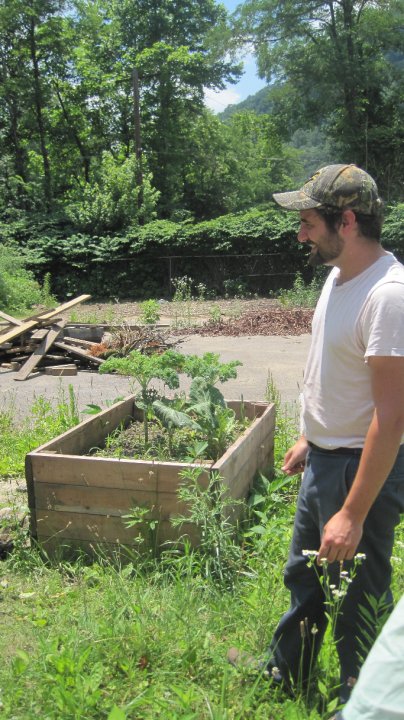
Farmer Jack at the Mullens Community Gardens.

However, Jack sees gardening as one step towards self-sufficiency for the people living in communities historically tied to the coal industry. In former times, the coal companies outlawed gardening in coal camps – thus making coal miners and their families dependent on purchasing food from the mercantile stores operated by the coal companies. Although growing gardens is no longer illegal, the coal companies still own 85% of the land in Wyoming county where Mullens is seated. Another 5% of the land is owned by state and federal government – leaving a mere 10% of land available to the people for housing, parks, gardens and businesses.

Visting a neighboring gardener and his horse Hank.

Coal is in the blood of the people,” one local woman from the organization, Friends of Milam Creek, told us. Out of the 20,000 people in Wyoming County, only 800 are employed in the coal industry. Employment in coal has drastically decrease with the rise in mechanization of the industry. Although most people living in coal country know at least one person who has died of black lung, jobs in the coal industry are the most sought-after. A coal miner with a high school education can make more money in a year than a college professor with a PhD. The balance of health-versus-wealth is a thin line to walk in the coal industry. Jobs for the remaining individuals span mechanical labor, food service and retail. Many area youth drift away from their communities when – and if – the opportunity arises.

Note: bumper sticker.

With all these thoughts muddling up my mind, we head out to the RAIL Community Garden – to mull over thoughts and pull some weeds. In addition to locating spaces for community residents to “farm” – there is a stigma attached to the lesser work of gardening – RAIL provides workshops on growing food, canning and preserving, and hosts a farmers market on RAIL’s property. Fresh food is grown for sale at market, for donation to food pantries, and for family consumption of those who grow it. We visited a few more gardens before harvesting some vegetables for our own dinner. At our last stop I noticed two bumper stickers both at the same house: “Nader/Gonzalez” and “I ‘heart’ Coal” – an interesting combination rarely replicated in any other community.

Note: political sign.

It doesn’t take an agrarian-minded person to connect the story of coal country economics in Appalachia to mechanized, mono-cropped agriculture in the Midwest. (The average age of a farmer in America today is 57.) Disillusioned youth are encouraged to seek educational opportunities elsewhere due to the lack of vocational attachment to the industry of the area. To leave is to succeed. Rarely applauded or honored are those who choose to stay. To mine. To farm. Outside do-gooders with liberal arts educations grounded in service to community are heralded by their own communities as heroes. But those who choose to stay are seen as having missed their golden opportunity.

West Virginia, Mountain Mama. Country roads, take me home.

End Day Seven. End Part Three.

Monday, June 21, 2010

Agrarian Road Trip: Part One.

background: this is a report from the road - about the Heaven on Earth Agrarian Road Trip - by a former WHRI intern. reasons to read on: the Agrarian Revolution is alive and well - like a handful of wriggling earthworms in fertile soil - and we need to share the stories of our brothers and sisters living the New Agrarian Dream. here is just a smattering of the projects happening elsewhere in the country. enjoy.

Garlic Pickin’, Potluckin’ and Llamas:

the Agrarian Tour through Kentucky and Tennessee

We – Agrarian Road Trippers – have been visiting and trading stories with many a farmer across Kentucky and Tennessee. Learning the tales of the trade and dreaming of the day when I will be a little old gray hair – well preserved, with her chickens and 12 varieties of tomatoes.

Day One: In Louisville, KY, we visited with the Refugee Agricultural Partnership Program - ½ acre in vegetable production, scattered across 30-some odd plots. Plots are sectioned by nationality – Burundi, Burma/Myanmar, Congo . . . and on and on, all finding a common language in compost and corn.

Day Two: Still in Louisville, we trek to Garden Summer Camp at Crescent Hill Presbyterian Church – a one-week summer camp with 15 kids, ages 8-14. All kids share morning chores harvesting vegetables for lunch, grinding corn for tortillas, tending chickens for eggs, and prepping beds for fall harvest. Each day of camp starts with a telling of a story about Father Coyote. In today’s lesson, Father Coyote studies a farmer sowing seeds – and then sows his own garden in order to harvest his own crop of happy little rabbits, lured to the garden by the fresh carrots and cabbage. The story touches upon irrigation techniques in the arid southwest, companion planting for bountiful harvest and the benefits of increased biodiversity in the garden. After the kids are tuckered out from their garden work and fresh lunch, they head to the pool for an afternoon swim.

Discussion with Ellen Davis – Old Testament Scholar from Duke Divinity School – who has recently written a book called Scripture, Culture and Agriculture: An Agrarian Reading of the Bible. Professor Davis focused on Exodus 16 as the basis for her research in understanding the cultural context of the Israelites exiled from the Egyptian Empire, for understanding the Modern Agricultural Empire. In a nutshell, the Israelites who have been freed from their slave masters take to complaining about lack of food. “At least when we were slaves of the Empire we have food enough to eat.” God has provided our daily sustenance (in the form of manna from heaven) – but instead the people grovel. Modern parables highlight our society’s dependence on – and enslavement to – genetically-modified, mono-cultured food-product that travels 1500 miles to our dinner plate. Rather than learning how to grow or can or cook our own food, we rely on a food system that is ever-increasing out of our hands and beyond our control.

Professor Davis takes our lesson one set further in analyzing the Greek roots of the closely related words adama and adam. Adama is Greek for “fertile soil.” Adam is Greek for “human.” The term adama is used in the Biblical context to refer to the land as ancestor of human – before Abraham there was adama. To create Man, God breathed His breath into adama. Now, I am no Biblical scholar, nor am I an Agrarian scholar – but that’s all pretty crazy amazing. We are dirt. Or rather, we are biologically breathing, o-so fertile soil.

soup bycycle.

Lunchtime: Lunch provided by Soup By-cycle, soups made using local, organic ingredients – delivered by bicycle to the Presbyterian Church USA (PCUSA) Headquarters in downtown Louisville for a wee little potluck with like-minded folks doing the work of the Church in the world. Some shared stories of recently travels to Haiti to protest against a recent Monsanto donation of genetically modified seeds to the region’s farmers. Instead of gladly accepting, the people of Haiti rebelled, by marching and burning the seeds. The introduction of GMO and hybrid seeds into cultures with a rich tradition of seed-saving poses a jungle of legal repercussions – linked also to increased suicides of peasant farmers in many countries.

Next stop – also in Louisville – Oxmoor Farms. The Field Day Farm at Oxmoor Farms partners with the Food Literacy Project to grow food for market and Community Supported Agriculture (CSA) as well as provide school-age education about local food systems. Situated on 8 acres tucked betwixt the interstate, golf course and a suburban subdivision, Farmer Seamus says golfer and farmer frequently meet eyes in questioning gazes. Ironic because there is a current trend where farms across the country are bought out by large residential developers due to a higher monetary value attached to land for its developmental potential rather than its agricultural productivity.

barn at oxmoor farms.

barn at oxmoor farms.

All that to say, we Agrarians harvested garlic and weeded kale while swapping stories about soil amendments and growing seasons. The garlic harvested was put into shares for Field Day Farm CSA – which supplies 60 families with produce each week. In addition to its CSA, extra produce is sold at 2 farmers markets each week and contributed towards Grasshopper, a cooperative multi-farm CSA supplying meat, cheese, milk, eggs, mushrooms to local families – in addition to regular shares of vegetables.

The beauty of a multi-farm (or multi-yard – reference fellow Wacoan Lucas Land’s Edible Yard Project) CSA is that it buffets the problems of pest invasion or crop failure, as well as taking advantage of the soil varieties and farmer specialization. Such a model also allows small gardeners who may not have enough to sell at market may contribute their produce and reap the benefits.

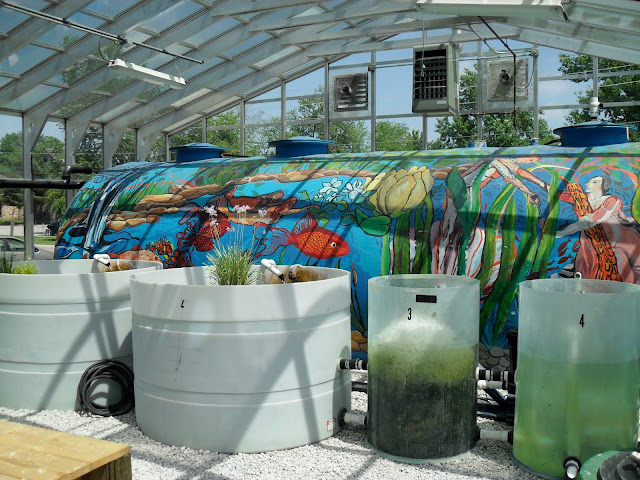
tilapia aquaculture at berea eco-village.

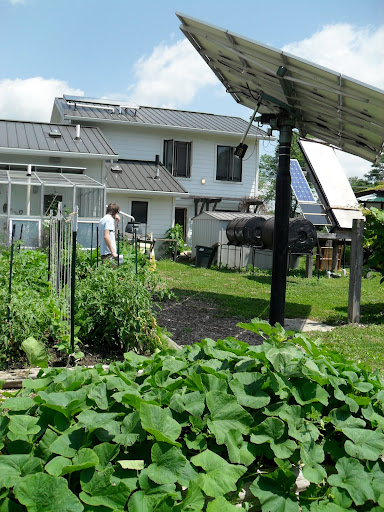
Day Three: We hit the road for Berea College in eastern KY to explore Berea’s Eco-Village and Farm Gardens. Professor Richard Olson expounded on his theories of the most-of-us speeding towards hell in a hand-basket – due to the rate we use electricity, water, petroleum, etc. (Sometimes doomsday global warming pessimism is not my cup of tea – it’s more like a cup of gas station coffee). After stepping off his soapbox, he showed us around Berea’s Eco-Village – ever-evolving with aquacultured tilapia, biointensive growing, photovoltaic (PV) panels, greywater treatment system as well as demonstrations in natural building, including: cob, cord wood with cob mortar, earth bag, earthen plaster, and straw bale. Berea’s Eco-Village is open exclusively for 4 interns in the Sustainability and Environmental Studies program – as well as students of Berea who are single parents.

garden and pv panels at berea’s eco-village.

From the Eco-Village, we journeyed to the other side of Berea College to the farm, gardens and greenhouse – a total area of 500 acres. In addition to vegetable production, Berea operates an apiary (honey flavored by blueberries and buckwheat), hoop houses for season extension, mushroom spore-infused-logs, and a cord wood root cellar. We were not able to see their livestock production – but Berea does that, too. All produce is sold at local farmers markets for a flat rate of $8/lb. The school also purchases produce for use in its cafeteria, at a rate of $6.50/lb. These prices are extremely high, for the majority of crops – but the people of Berea are willing to pay. The farm and gardens are maintained by students in the College’s Agriculture Department. All students at Berea are required to work for tuition (10-15 hours/week) – no other costs are associated with tuition. Another similar college is School of the Ozarks in Missouri.

cord wood structure.

Vegetables grown at Berea College are Certified Organic – meeting the USDA’s standards and definitions of organic practices. Organic certification is a highly contentious topic amongst small scale agrarians. Both Field Day Farm at Oxmoor Farms in Louisville and World Hunger Relief Farm in Waco choose not to certify their produce – although each farm meets, and exceeds, the USDA’s standards. Farmer Igor at Field Day Farm choose not to certify due to moral convictions – both that the standards are too loose, while being relatively expensive. He also notes that small scale farming is about relationship with the consumer – and if a strong relationship is in place, all farming practices are transparent – and thus certification is unnecessary.

llama lovin’ at liles organic acres.

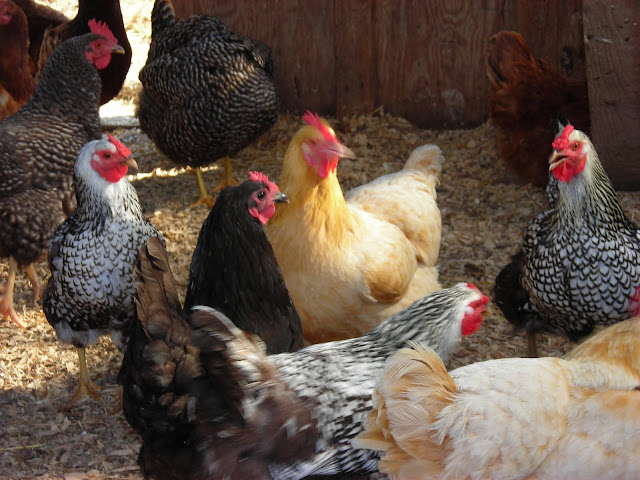
After Berea, we traveled to Maryville, TN – to visit Liles Organic Acres, a small family farm operated by Sheri and Russell Liles. Here we met the llamas. Sheri – a self-proclaimed back-to-the-land hippie – showed us around the farm. She grows vegetables in 25 raised beds – that have been double-dug and enriched each year with layer upon layer of compost. She and Russell keep seven compost piles around the farm – enriched by rabbit, llama and chicken poop – as well as leaves, food scraps and red wigglers. Her vegetables are sold at market – and chooses not to certify organic. In addition to vegetables, Sheri also keep llamas and angora rabbits from which she can spin the wool – as well as growing cotton and flax, to be spun by her mother-in-law for linen. Both Sheri and Russell work part-time off the farm – she as a nurse practitioner, he as a picture-framer. Russell is also a crafted wood-worker and quite engineer-ed-ly minded, installing PV panels that supply 25% of their energy use and building the llama barn, chicken coops and beehives.

chickens at liles organic acres.

Once we departed the Liles farm, we met up with locals from the Highland Presbyterian Church in Maryville – to share stories and recipes over a potluck of locally produced grub.

End Day Three. End Part One.

- bethel, agrarian road tripper.

Monday, July 13, 2009

Food in the Bible: Sabbath

When I wrote a post on Joseph's experiment in redistribution, I was stunned by what I found. It is still profoundly disappointing to see such injustice, particularly in our own scripture. As I pondered that, however, I thought that perhaps the Year of Jubilee in Leviticus 25 is the antidote. In Joseph's story he tries to bring about a just distribution of goods and fails miserably. In Leviticus 25 we are given a model that seems to undo this kind of injustice, but scholars tell us it was probably never tried. This idea that Jubilee is the antidote to our failing human efforts at justice brings me to a foundational concept in Scripture that serves as a basis for much of my thinking on food, poverty and justice... Sabbath.

J.D. Crossan in God and Empire says, "It is not humanity on the sixth day but the Sabbath on the seventh day that is the climax of creation... our 'dominion' over the world is not ownership but stewardship under the God of the Sabbath" (53). The reason that scripture gives for observing the Sabbath is not worship, which most Christians and maybe Jews seem to think. The reason given is so that the slaves and foreigners could have rest as well (Ex 23:12; Deut 5:14). Again Crossan says,
The Sabbath Day was not rest for worship, but rest as worship... In summary, the Sabbath was about the justice of equality as the crown of creation itself (54).
The Sabbath Day is extended to the Sabbath Year (Ex 21:2 and Deut 15) and finally the Sabbath Jubilee (Lev 25). Every seventh year both male and female slaves were to be set free and debts were remitted, or forgiven. Provisions are given for both male and females to ensure that they are cared for within the social context of the time. Both male and female slaves are to be restored to a just and equal standing in the community when they are set free. Deuteronomy warns that masters should not consider this a hardship. Lenders are also warned that they should not withhold loans from their needy neighbors when the seventh year is close. "Your neighbor might cry to the Lord against you, and you would incur guilt" (Deut 15:9)

The Jubilee goes even further by commanding that every seventh Sabbath Year "you shall return, every one of you, to your property and every one of you to your family" (Lev 25:10). God had divided the land up between the tribes, but knew that inevitably inequality and injustice would creep in. The Jubilee is the final rule that prevents inequality from remaining within the people of God. Lest we think this applies only to Israel or the church, remember that the purpose of God's covenant with Abraham constituting the people of God was that "all the families of the earth shall be blessed" (Gen 12:3). Israel was meant to be a model to the rest of the nations of what it meant to live in relation to God and each other.

The Sabbath was not just about people either.

"For six years you shall sow your land and gather in its yield; but the seventh year you shall let it rest and lie fallow, so that the poor of your people may eat; and what they leave the wild animals may eat. You shall do the same with your vineyard and your olive orchard" (Ex 23:10-11).

The whole of creation rests on a foundation of balance between work and rest. This passage also clearly indicates the relationship between the work and rest of the land and the people as well as the implications for equality and justice. Thus the right ordering of relationships, between people and between people and the earth involves a balance of work and rest which ultimately results in just distribution of resources.

Crossan sums it up by saying that through the progression of Sabbath laws "we can see clearly the demand of God for a just distribution of land-as-life based on the creation theology in Genesis 1:1-2:4a" (71).

Originally posted at What Would Jesus Eat? this is part of an ongoing series reading through the Bible with food as a lens.