

Sharing Our Stories over Cherry Pie, Blueberries and Beer:
the Agrarian Tour at the 2010 US Social Forum
In this our final leg of the journey, we – Agrarian Road Trippers – shared many a story with many an agrarian minded folk in Detroit – locals as well as way-faring strangers flocking to the US Social Forum – to prove “Another World is Possible, Another US is Necessary, and Another Detroit is Happening.”
Day Ten:
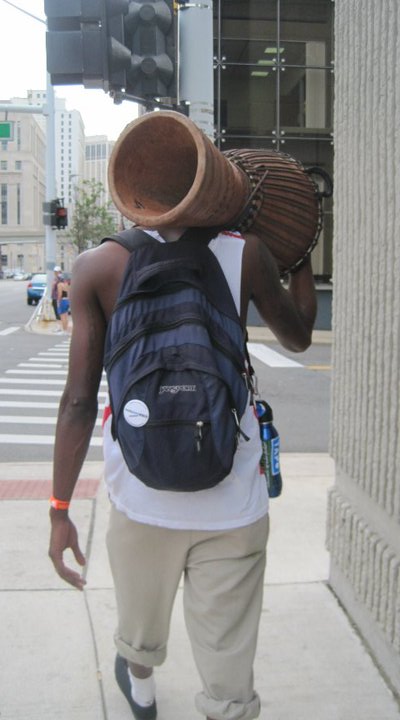
Headed towards our workshop.
“Faith Communities in the Local Food Movement: Sustainable and Just!” – this is the culmination of our wayward travelings on the road. A workshop at the US Social Forum, by us. One of thousands. And close to a hundred other workshops happening at the same time as ours, including: “The Coalition of Imokalee Workers: Fighting for Fair Food” and “Re-Purposing Auto Factories to Manufacture Renewable Energy Infrastructure” and “How to Start a Raging Grannies Group.” With over 17,000 people expected to be in attendance, how were we to compete against Raging Grannies? We set our expectations low – maybe four people will show. If we’re lucky, the crowd will outnumber us presenters (15). Thankfully, the good Lord provided, and we hosted a crowd near 60.

Recruiting participants for our workshop.
Andrew (organizer for the Presbyterian Hunger Program – and our fearless leader) introduced our tour with the aid of Blain, morphing into a tale of our trip across eight states led by Kate. Three gals (Amy, Laura, and yours truly) shared a testimony of the work we are doing at home, connecting the realms of faith and food justice. Then we split into small groups to learn about the good work of those so politely listening to our journeys. To emphasize the faith component of our time on the road, Talitha expounded upon our beloved passage from Exodus 16, first shared with us by Ellen Davis back in Louisville, before we calmed our minds for a sacred eating reflection. Jud passed around blueberries, asking us to think of all the people who came into contact with this blueberry before it finally reached us. The farmworker, truck driver, grocery store employee, cashier, Monsanto madman, etc. Then we closed our eyes, thinking about the life of just one of those people, while savoring all the flavors of that one blueberry. We opened our eyes to share our experiences and continue our fellowship, sharing how we want to be involved in our food systems back home – and help our faith communities with our food systems.
Not everyone was a Christian. Not everyone was connected to their food systems. But that was the beauty of our communion together. We just set aside a little time to share a sacred meal. Together.
By Any Greens Necessary: Food as a Tool of Colonization and Joining the Resistance
This is the first workshop I attended. Intense. Hosted by Jade Walker, farmer from Mill Creek Urban Farm, and Chris Bolden-Newsome, farm educator at King High, both in West Philadelphia. Led our discussion about the struggles and movements of indigenous people throughout history for food sovereignty. We split into groups to discuss: Black Panther free breakfast program (before the USDA), Native American fry bread as example of dominate culture becoming sacred, Cochabamba Water War over the privatization of water in Bolivia, Landless Farmworkers Movement in Brazil to reclaim the commons for the benefit of all, and so many more. My group discussed the Zapatistas as reaction to the NAFTA signing in 1994 – and its impact on Mexico. A man from Mexico was in my group – and shared from personal experience how the trade agreement affected his family, farming and flight to the US.

Farmers fighting back, the MST - Landless Workers Movement - in Brazil.
We discussed organizing tactics – and the basic fact that WE ARE ONLY LIMITED BY OUR IMAGINATIONS! That the struggle for food sovereignty is still happening. As Jade said, “Colonization is not over. Sometimes it looks like gentrification. Sometimes it looks like limited access to resources.” As we continued to delve deep into these struggles, we were faced with our own stories – the stories of our people, the stories of our connection to the land. Our stories are our resistance to a culture that wants us to accept French fries as food, television as community. Our stories must be shared.
Re-Localization and the Role of the Rustbelt.
Next, hanging out with the Michigan Young Farmers Coalition to hear about some of their young farmer stuff. Gardens. Farms. Animals. Hoop Houses. Hoorah! One particular project – the Haven Garden Project - was started by a Michigan State Ag student with a womens shelter in Pontiac, MI, using permaculture methods and the resources of MSU’s greenhouses and other resources. The shelter serves 15,000 women each year. Limited access to fresh food in the community. Growing food for the shelter on 1/5 acre – improving the soil with compost to build raised beds. Surplus goes to a food pantry. Starting a relationship with a local chef to teach the women what to do with the food they grow.
After another day of food and farming, I was burnout. So my new Agrarian friends and an old farm buddy met up for a taste of the local culture at Motor City Brewing Works, a local microbrewing specializing in handcrafted ales and o-so delicious pizza. (Darren’s favorite: Mary-Had-A-Little, topped with roasted lamb!) Then to rest for another full day.
Day Eleven:
My first workshop was canceled – with two very large, armed men standing outside the entrance. So I made my way to another workshop, led by the Rainforest Action Network. Because of our visit to Mullens, WV, communities living in coal country have now caught my attention. So I thought I would attend and not start trouble with the large, armed men. Activists convened to hear the story of one woman who has lived life, not in coal country, but in a community where the coal industry has decided to mine: “We don’t live where they mine coal; they mine coal where we live.” Her husband worked for the coal industry for 35 years, before dying of Black Lung. Now she feels she has no choice but to speak against the industry that has made her home Ground Zero for coal excavation. She expounded on the millions of pounds of ammonium nitrate used everyday to blow the tops off mountains – the same ingredients Timothy McVeigh used for the Oklahoma City Bombing. “When it happened in Oklahoma City, it was a tragedy. When it happens in Appalachia, it’s called progress.”

Coal: the tension between activism and the economy.
Of course, the solution to mountaintop removal is not clean cut. Communities may be 100% against mountaintop removal while being 100% dependent on coal for energy. Another tension arises between activists wanting an end to the use of coal vs. communities that are dependent on coal for employment – an issue that became apparent at the workshop.
Regarding health and environmental quality, the people of Appalachia have nothing to lose, and everything to gain. But their story needs to reach beyond the hills and the hollers, into a larger forum. Only 8% of the coal that the US uses for energy is sourced from the Appalachian Mountain region, with the rest strip-mined from western plains regions. Yet, Appalachia has the most dense population of all regions where coal is sourced – thus making mountaintop removal the low-hanging fruit in our nation’s transition away from dependence on coal.
After almost ending mountaintop removal, I headed to a wonderful little street a few blocks away from Wayne State University, where many a local business thrived. Lunch was supplied by the wonderful hands of workers at Avalon International Breads and Goodwells. Then I bought the latest book by Gayla Trail, called Grow Great Grub: Organic Food from Small Spaces at an independent bookstore, part of the Spiral Collective.

Reclaimed house (one of many) at the Heidelberg Project.
After lunch, I joined a few friends to visit some Detroit hot-spots. First, the Heidelberg Project. An avant-garde art project, reclaiming a few blocks in Detroit – houses and all – into a massive waste-infused piece of art. Reflecting on themes such as stories told in taxis, created in God’s image, and many more subtle-ly overt political messages – a pink hummer buried in the ground, sprouting flowers.

Code Pink Hummer at Heidelberg Project.
Next stop, Earthworks Farm. Started by Capuchin monks to provide food for a neighborhood soup kitchen. Also providing seeds and plants for community gardens throughout the city, as coordinated by the Greening of Detroit. My favorite part: the Compost Monster, resembling the Loch Ness monster atop a huge heap o’ compost.
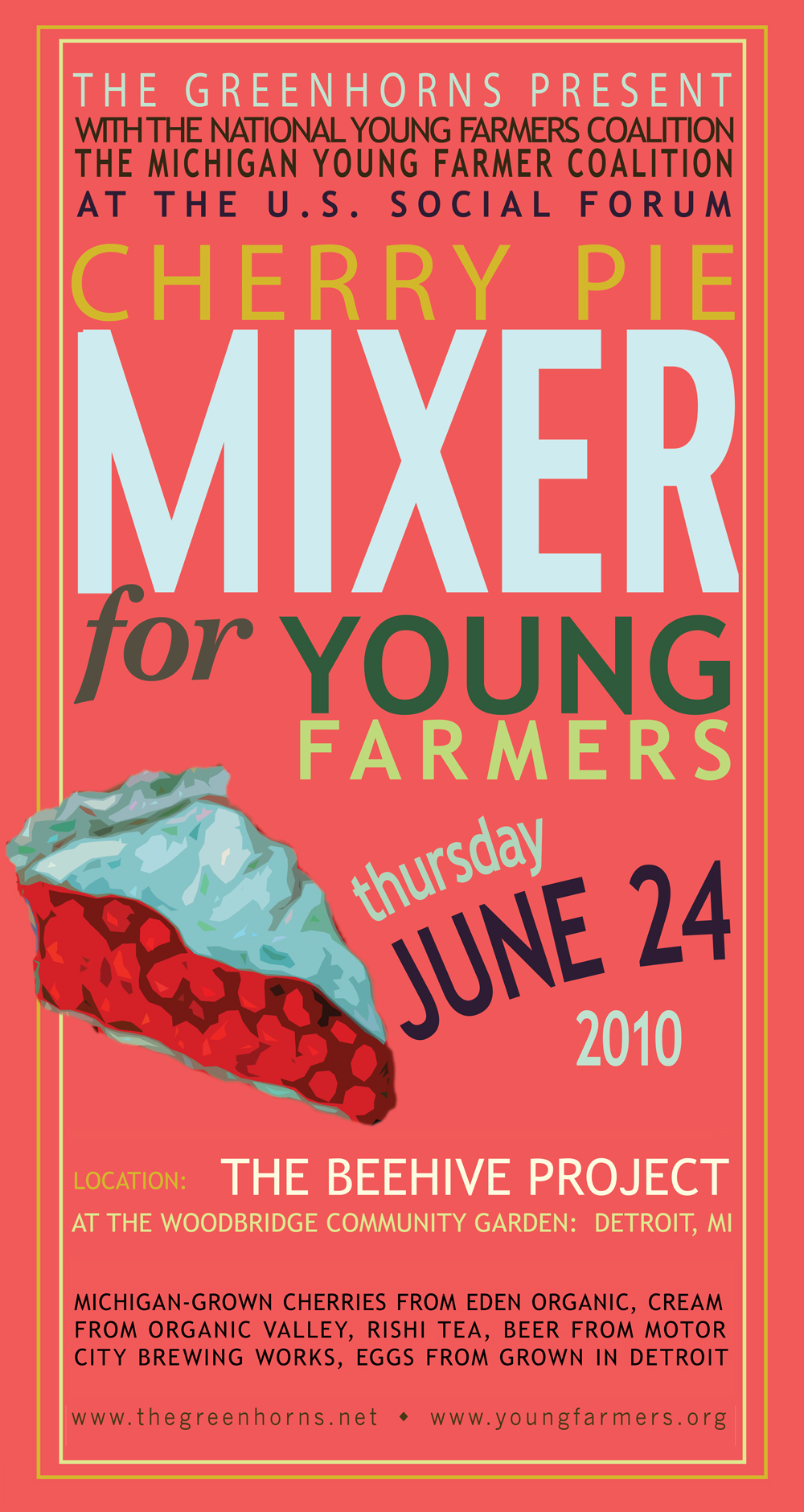
Flyer for the Cherry Pie Mixer.
Not completely garden-ed out for the day, we headed to the Young Farmer Cherry Pie Mixer organized by the Greenhorns at the Woodbridge Community Garden. And boy, was there cherry pie! So we mixed and mingled, pie in hand, with other young farmers and farm supporters, from Michigan and Missouri and Maine and California. I talked with one man who was in the mead-making business and thus decided to start harvesting his own honey, setting up hives across the city of Detroit. Before long, we were gathered together via bullhorn and given an introduction by Severine von Tscharner Fleming, documentarian and Greenhorn. Then Reverend Billy from the Church of Stop Shopping shouted us some proclamations about the revival of small agriculture in the face of overwhelming empire. Shortly thereafter, a keg of Motor City Brewing Works finest Ghettoblaster ale was tapped inside the up-and-coming art project of the Beehive Project, a “large-scale installation by an interdisciplinary community of artists and thinkers in Detroit” – not to be confused with the Beehive Collective, also awesome.

Reverend Billy preaching in front of the Beehive.
Tired and to bed.
Day Twelve:
BikeIt: Pedal to the USSF – Testimonials and Exploration of the Bicycle as a Tool for Social and Environmental Justice.
Welcome to the last day of thinking – for a while. Being a promoter of pedal-powered transit (even while in a skirt, transporting garden tools), I decided to buckle down with some bike riders. Two main bike contingencies shared their stories about biking to the US Social Forum. One from Ithaca, NY – covering 500 miles in 8 days. The other from Madison, WI – covering 300 miles in 8 days. Coordinated through the Bike-It Project, organized to promote biking alternatives and push both physical and mental limits. Each of the groups were followed by support vehicles – including the Permaculture Bus from Montana. Each made stops in communities to volunteer and build community within the collective through skill shares. Ages of bikers ranged from 9 to mid-70s. Bike collectives represented: Spoke ‘N Heart Collective (Atlanta), the Garlic Derailleurs (Chicago), the Grassroots Caravan (Madison) and the Petrol-free Gypsy Carnival Tour.

Saddle bag for bike made from refashioned kitty litter boxes - workshops lead by Petrol-free Gypsies.
Beyond sharing stories, we collectively identified issues and inhibitors of bicycles as the main form of transportation – as well as populations typically marginalized from biking communities. And brainstormed ways of making biking accessible to all, while building community and sharing skills while delving into the deeper topics of race and privilege. This is the beauty of the bike. To pass through new places and ponder the people and their stories.
We Agrarians gathered together for the rest of the afternoon to process yet we had learned – and what to do with all that stuff once we got back to our places of origin. This was also our farewell. Might I add that a number of our Road Trippers will be returning home to plant gardens and wear more plaid.
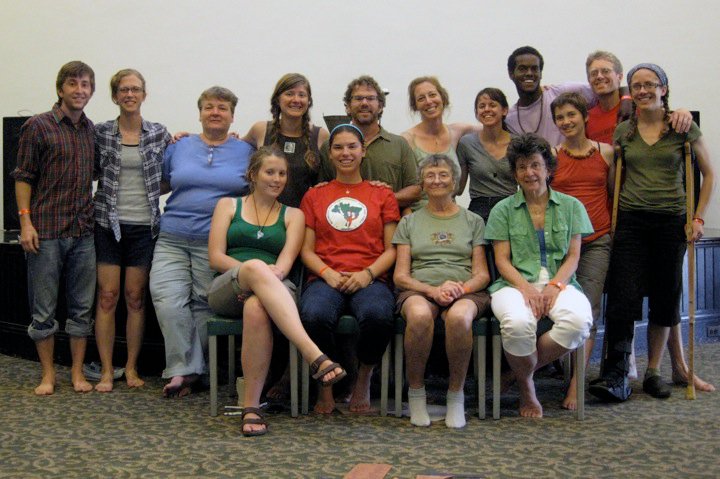
Road Tripper group photo on our last evening together.
Day Thirteen:
Already some of our group had disbanded before breakfast. The rest of us headed to Detroit’s famed Eastern Market for some good eats before hitting the road (watch the video of our trek through the Market). The Eastern Market has been in existence since 1891 – and currently is a common source for groceries for a number of residents in Detroit. While there are a fair share of resellers (all those “farmers” who sell produce with stickers on them), there were a plethora of local bakers, urban farmers, and cheese makers. Even a few Amish farmers who start their trek to Detroit at 2am every Saturday. I also located my honey man and bought a jar of his Wild Detroit Honey.

Getting a wee bit road weary at the Eastern Market.
Then we started on our road home. Or at least to Louisville. And that’s where my story ends.

Ready to hit the road for home.
End Day Thirteen. End Part Six.
