Showing posts with label Food. Show all posts

Wednesday, August 4, 2010

Texas at the Table: Part Four.

Preservative Pickles, Cardboard Apples, and the Theology of Disposable Dishware

at the Table in San Antonio, TX

While surveying the sights in San Antonio, we – the lovely ladies of the Texas at the Table: Project Go Road Trip – experienced the full spectrum of emotion – from shock and awe, disillusionment and hope. We discovered new insights into everyday theology – through eating red delicious apples and washing mismatched dishes. San Antonio was the fourth stop on the Texas at the Table Road Trip to explore how people across Texas creatively address hunger in their communities – or more simply, exploring where food comes from, who gets it, and who doesn’t.

Day Ten: After basking in the sun for an afternoon and unwinding in a cabin in the hill country, we dove back into summer feeding frenzy in San Antonio. Our first stop was Baptist Temple Church to meet with Pastor Jorge Zayasbazan. Baptist Temple was one of the first churches in San Antonio to initiate a summer lunch program for neighborhood children. In their second summer, Baptist Temple now hosts summer camp five days a week, providing programming for kids all morning long and ending with a lunch. In San Antonio, the summer lunch program is sponsored by the San Antonio Food Bank to coordinate the food distributed to the various lunch sites across the city. Pastor Jorge led us through the kitchen to show us a bagged lunch prepared by the Food Bank – a hot dog wiener, pickle-in-a-pouch, fruit cocktail, and fruit cereal bar. If enough time and hands are available, the hot dogs will be heated up in the microwave before served to the children in a white bun. My fellow Road Trippers – already having their fill of hot dogs – were aghast at the nutritional deficiency of said meal. And yet such meals meet the US Department of Agriculture’s nutritional standards of a healthy meal.

the beautiful San Antonio Food Bank.

From Baptist Temple, we jumped in the cars, stuffed some carrots, cucumbers and hummus in our mouths and headed towards the San Antonio Food Bank to meet with Paco Velez, Director of Services – to take a tour of the city programs with which the Food Bank partners. First stop, a neighborhood center summer program for teens. This program was co-sponsored with HEB and Radio Disney. When we walked through the doors, we were hit with the smell of sweaty adolescence, or should I say, teen spirit. Radio Disney led dancing-jazzercise wonderful-ness with the teens. The HEB mascot handed out apples. The overall focus of the program is health and fitness. I spoiled the good vibes by politely declining the offer of an apple, because personally, I think red delicious apples taste like cardboard – and out of all the hundreds varieties of apples, I have no idea why we as a culture have adapted the red delicious apple as the apple of choice. If I were a teacher and a student of mine handed me a red delicious apple, I would promptly compost it. Perhaps this is a bit harsh, but food grown for artificial appearances preserved to have a shelf-life of 6 months should not be considered edible. Chemicals are used to keep the food-product looking fresh, while the sugar content (ie flavor) begins to deteriorate the moment it is plucked from the branch. This is not food. And this is why our children do not eat their vegetables. Or red delicious apples. Or fruit infused-in-high-fructose-corn-syrup cocktail. And also a contributing factor to the increasing rate of adult-onset diabetes and obesity amongst our children. Excuse my rant.

Teen Center partnering with San Antonio Food Bank.

After the youth center, Paco took us to a senior center distributing senior food boxes in addition to what the social worker side of me chooses to refer to as the diabetes line – donations from HEB of all the day-old pastries, cakes, cookies, breads. Don’t get me wrong – I truly appreciate attempts to salvage food from waste (and am an avid dumpster diver of groceries and used to rescue hundreds of $$$ worth of fresh produce from my local Trader Joe’s) – however, as a former case manager for low-income and homeless families, it pains me to see people who have lost their sight, toes, or whole legs to diabetes reaching for that free cake donated by HEB. Let them eat cake, indeed! If we want to adequately fix our broken health care system while attempting to end hunger in our communities, we must understand and emphasize the importance of good nutritious food. A shift must occur socially and culturally. Those of us from higher economic brackets who prefer fresh organic food – be it from HEB, Central Market or Whole Foods – musn’t reach for the can of creamed corn and bag of ramen noodles that we wouldn’t feed ourselves or our children when the next food drive for the church food pantry hits us in the face. If we have respect for our own bodies and own health – as well as that of our children – then as Christians (if we claim to believe in God and the words Jesus said to love our neighbors as ourselves) we must also respect the health and well-being of our brothers and sisters we serve at food pantries, on the street, at work, next door. Excuse my rant.

Filling a food box at a senior center.

Next stop: one of the Food Bank’s drive-thru food box distribution sites. Typically the Food Bank requires that a parking lot can accommodate 500 cars in order to qualify as a site. The site is complete with canopies covering everything from potatoes to beverages to rice and more is hand-loaded by Food Bank employees into the trunks and backseats of those willing to sit idling in the parking lot. Qualifications: folks must have a child under 18, call ahead to the Food Bank to reserve a box, and be willing to take the time in the morning or afternoon to wait in line. Such a food distribution presupposes transportation and gas money.

Drive-thru food box distribution.

Our last stop before heading back to the Food Bank was the infamous Haven for Hope, a multi-million dollar response to homelessness in San Angelo. As our friend Steven from Austin explained, Haven for Hope is the Walmart of the social service world: one stop shopping for the homelessness community, providing a multitude of programs and gated community setting – and slowing putting smaller homeless assistance programs out of business with the consolidation of funding and services focused on Haven for Hope. The Food Bank’s role at Haven for Hope is food, of course, as well as a Culinary Arts Training Program – allowing residents to participate in a job-readiness program. We benefited from some of the program’s red velvet cake.

Looking at aspargus at the Food Bank Garden.

Finally, the Food Bank operates a garden on the site of the main headquarters. I led the gals for a plant identification tour – testing their increased knowledge of various vegetables and herbs. Upon asking Paco about the Food Bank’s sourcing of fresh produce, he told me they work with one of the largest produce warehouses in the state of Texas – which donates millions of pounds of vegetables and fruit each year. The Food Bank also encourages community partners to start their own gardens, providing seeds and tools to help get their gardens started.

the Lovely Ladies with Paco.

That evening we had a terrifying experience had an HEB-plus on the south side of the city. I would also like to comment that any and all of my rants are not against the San Antonio Food Bank specifically. The SAFB is one of the best food banks in the nation, distributing large amounts of food to those in their community who need that extra support. They do good work. However, I am continually frustrated when efforts to address hunger in the community are haphazardly bandaged through quick fixes of food-products devoid of nutritional value – while the plight of the family farmer is furthered by our societal reliance upon agri-business and corporate conglomeration of our food system. Seems like there should be a solution in there some where to connect the idea of growing food with the issue of ending hunger, while economically benefiting small growers and the local community at the same time . . . Excuse my rant.


Day Eleven: Friday morning our view of San Antonio – and the entire trip – shifted. Rather than continuing to see refined programs tailored to look good in funding pamphlets, we saw down and dirty service to community. We metwith Dee Sanchez, volunteer at the San Antonio Catholic Worker House – who, first things first, led us in a devotion centered on Matthew 25, integrating Jesus’ message into the work of the Catholic Worker house – feeding the hunger, providing shelter to the homeless, doing laundry, sharing conversation, sharing coffee, etc. The Catholic Worker Movement started many moons ago when a fiesty young woman – Dorothy Day – and simple agrarian-minded man – Peter Maurin – frustrated by the Church, decided to become the hands and feet of Christ through inner-city and agricultural hospitality. Today many Catholic Worker Houses are scattered across the country, continuing in the fiesty agrarian spirit of Dorothy and Peter. We Road Trippers truly felt that all who entered this old house were truly welcome. We spent the morning in the crowded kitchen of the house preparing lunch for whomever might show up. Potatoes were chopped, boiled and mashed. Donations of meat from a local rib joint were brought in. Herbs gathered from the garden. Vegetables chopped for salad. Peaches prepped for peach cobbler. Men wandered in and out, grabbing a hot cup of coffee on this 100-plus degree day. Folks came in to sign up for the laundry list. Some wanted to look through the clothing closet. Others volunteered to wash dishes. All was chaos – clanging of plates, swapping of stories – 50 at one time, sweaty bodies huddled over the chopping block. And yet through the chaos of it all – we loved it. Rather than receive food and donations from the San Antonio Food Bank or applying for government funding, the Catholic Worker House relies on donations from charitable folks in the community, praying God will provide day by day.

the San Antonio Catholic Worker House.

While preparing the meal, we heard stories of people on the streets. Some struggling to get into Haven for Hope and expressing their frustration with the lack of transparency of the program. Neither of the two claimed to do drugs, struggle with alcohol or have a history of abuse – which are key issues for getting a bed quickly at Haven for Hope. Rather they are the in-betweens, sleeping outside huddled against the building. They are allowed to take showers – but the stalls are only half-height and the toilets have no doors. Lunch is a cold sandwich in a brown bag. This couple has fallen through the cracks, like many other folks we meet – and this is where the Catholic Worker House opens its doors. For those who fall through the cracks. A hot meal is provided – with mashed potatoes, made from real potatoes, not off-brand flakes. And the dishes are real, not disposable. Another pet peeve of mine – disposable dishes. And not for the eco-elite reason of not being environmentally sustainable – but because of dignity. You would wash dishes for your family . . . If we serve people disposable food on disposable dishes, soon people begin to understand themselves as disposable people.

We served over 100 people for lunch that day – without air conditioning, without a dishwashing machine, without the Food Bank, without the government. As Dee said, “Love in Reality is a harsh and dreadful thing as compared to the Love in Dreams.” After cleaning up, we were plumb tuckered out and went back to our apartment at Baptist University of the Americas – and order a pizza from our local Pizza Hut . . .

Pearl Brewery Farmers Market.

Day Twelve: A more relaxed day. Drove to the Farmers Market at Pearl Brewery, where we bought some vegetables, sniffed some lavender, and browsed some books. Then we traipsed through Whole Foods – a first for the gals. So I gave them my Whole Foods plan of action – walk the perimeter and look for free food samples; walk the interior for free food samples; and walk the perimeter once more for free food samples. I also pointed out the Diva Cup – which I won’t get into here – but I had already given my 2-cents worth about being more sustainable during that time of the month. We ate lunch at Whole Foods before the gals scampered off to play sand volleyball in the scorching hot sun, with the two German Brethren volunteers we met at the Catholic worker house the day prior. Then we met up for dinner at Casa Rio and perused the River Walk, on the prowl for adventure. Finding none, we went home for a good night’s sleep before our drive to the Valley.

the San Antonio Riverwalk.

End Day Twelve. End Part Four.

Monday, July 5, 2010

Agrarian RoadTrip: Part Six.

Sharing Our Stories over Cherry Pie, Blueberries and Beer:

the Agrarian Tour at the 2010 US Social Forum

In this our final leg of the journey, we – Agrarian Road Trippers – shared many a story with many an agrarian minded folk in Detroit – locals as well as way-faring strangers flocking to the US Social Forum – to prove “Another World is Possible, Another US is Necessary, and Another Detroit is Happening.”

Day Ten:

Headed towards our workshop.

“Faith Communities in the Local Food Movement: Sustainable and Just!” – this is the culmination of our wayward travelings on the road. A workshop at the US Social Forum, by us. One of thousands. And close to a hundred other workshops happening at the same time as ours, including: “The Coalition of Imokalee Workers: Fighting for Fair Food” and “Re-Purposing Auto Factories to Manufacture Renewable Energy Infrastructure” and “How to Start a Raging Grannies Group.” With over 17,000 people expected to be in attendance, how were we to compete against Raging Grannies? We set our expectations low – maybe four people will show. If we’re lucky, the crowd will outnumber us presenters (15). Thankfully, the good Lord provided, and we hosted a crowd near 60.

Recruiting participants for our workshop.

Andrew (organizer for the Presbyterian Hunger Program – and our fearless leader) introduced our tour with the aid of Blain, morphing into a tale of our trip across eight states led by Kate. Three gals (Amy, Laura, and yours truly) shared a testimony of the work we are doing at home, connecting the realms of faith and food justice. Then we split into small groups to learn about the good work of those so politely listening to our journeys. To emphasize the faith component of our time on the road, Talitha expounded upon our beloved passage from Exodus 16, first shared with us by Ellen Davis back in Louisville, before we calmed our minds for a sacred eating reflection. Jud passed around blueberries, asking us to think of all the people who came into contact with this blueberry before it finally reached us. The farmworker, truck driver, grocery store employee, cashier, Monsanto madman, etc. Then we closed our eyes, thinking about the life of just one of those people, while savoring all the flavors of that one blueberry. We opened our eyes to share our experiences and continue our fellowship, sharing how we want to be involved in our food systems back home – and help our faith communities with our food systems.

Not everyone was a Christian. Not everyone was connected to their food systems. But that was the beauty of our communion together. We just set aside a little time to share a sacred meal. Together.

By Any Greens Necessary: Food as a Tool of Colonization and Joining the Resistance

This is the first workshop I attended. Intense. Hosted by Jade Walker, farmer from Mill Creek Urban Farm, and Chris Bolden-Newsome, farm educator at King High, both in West Philadelphia. Led our discussion about the struggles and movements of indigenous people throughout history for food sovereignty. We split into groups to discuss: Black Panther free breakfast program (before the USDA), Native American fry bread as example of dominate culture becoming sacred, Cochabamba Water War over the privatization of water in Bolivia, Landless Farmworkers Movement in Brazil to reclaim the commons for the benefit of all, and so many more. My group discussed the Zapatistas as reaction to the NAFTA signing in 1994 – and its impact on Mexico. A man from Mexico was in my group – and shared from personal experience how the trade agreement affected his family, farming and flight to the US.

Farmers fighting back, the MST - Landless Workers Movement - in Brazil.

We discussed organizing tactics – and the basic fact that WE ARE ONLY LIMITED BY OUR IMAGINATIONS! That the struggle for food sovereignty is still happening. As Jade said, “Colonization is not over. Sometimes it looks like gentrification. Sometimes it looks like limited access to resources.” As we continued to delve deep into these struggles, we were faced with our own stories – the stories of our people, the stories of our connection to the land. Our stories are our resistance to a culture that wants us to accept French fries as food, television as community. Our stories must be shared.

Re-Localization and the Role of the Rustbelt.

Next, hanging out with the Michigan Young Farmers Coalition to hear about some of their young farmer stuff. Gardens. Farms. Animals. Hoop Houses. Hoorah! One particular project – the Haven Garden Project - was started by a Michigan State Ag student with a womens shelter in Pontiac, MI, using permaculture methods and the resources of MSU’s greenhouses and other resources. The shelter serves 15,000 women each year. Limited access to fresh food in the community. Growing food for the shelter on 1/5 acre – improving the soil with compost to build raised beds. Surplus goes to a food pantry. Starting a relationship with a local chef to teach the women what to do with the food they grow.

After another day of food and farming, I was burnout. So my new Agrarian friends and an old farm buddy met up for a taste of the local culture at Motor City Brewing Works, a local microbrewing specializing in handcrafted ales and o-so delicious pizza. (Darren’s favorite: Mary-Had-A-Little, topped with roasted lamb!) Then to rest for another full day.

Day Eleven:

Ending Mountaintop Removal

My first workshop was canceled – with two very large, armed men standing outside the entrance. So I made my way to another workshop, led by the Rainforest Action Network. Because of our visit to Mullens, WV, communities living in coal country have now caught my attention. So I thought I would attend and not start trouble with the large, armed men. Activists convened to hear the story of one woman who has lived life, not in coal country, but in a community where the coal industry has decided to mine: “We don’t live where they mine coal; they mine coal where we live.” Her husband worked for the coal industry for 35 years, before dying of Black Lung. Now she feels she has no choice but to speak against the industry that has made her home Ground Zero for coal excavation. She expounded on the millions of pounds of ammonium nitrate used everyday to blow the tops off mountains – the same ingredients Timothy McVeigh used for the Oklahoma City Bombing. “When it happened in Oklahoma City, it was a tragedy. When it happens in Appalachia, it’s called progress.”

Coal: the tension between activism and the economy.

Of course, the solution to mountaintop removal is not clean cut. Communities may be 100% against mountaintop removal while being 100% dependent on coal for energy. Another tension arises between activists wanting an end to the use of coal vs. communities that are dependent on coal for employment – an issue that became apparent at the workshop.

Regarding health and environmental quality, the people of Appalachia have nothing to lose, and everything to gain. But their story needs to reach beyond the hills and the hollers, into a larger forum. Only 8% of the coal that the US uses for energy is sourced from the Appalachian Mountain region, with the rest strip-mined from western plains regions. Yet, Appalachia has the most dense population of all regions where coal is sourced – thus making mountaintop removal the low-hanging fruit in our nation’s transition away from dependence on coal.

After almost ending mountaintop removal, I headed to a wonderful little street a few blocks away from Wayne State University, where many a local business thrived. Lunch was supplied by the wonderful hands of workers at Avalon International Breads and Goodwells. Then I bought the latest book by Gayla Trail, called Grow Great Grub: Organic Food from Small Spaces at an independent bookstore, part of the Spiral Collective.

Reclaimed house (one of many) at the Heidelberg Project.

After lunch, I joined a few friends to visit some Detroit hot-spots. First, the Heidelberg Project. An avant-garde art project, reclaiming a few blocks in Detroit – houses and all – into a massive waste-infused piece of art. Reflecting on themes such as stories told in taxis, created in God’s image, and many more subtle-ly overt political messages – a pink hummer buried in the ground, sprouting flowers.

Code Pink Hummer at Heidelberg Project.

Next stop, Earthworks Farm. Started by Capuchin monks to provide food for a neighborhood soup kitchen. Also providing seeds and plants for community gardens throughout the city, as coordinated by the Greening of Detroit. My favorite part: the Compost Monster, resembling the Loch Ness monster atop a huge heap o’ compost.

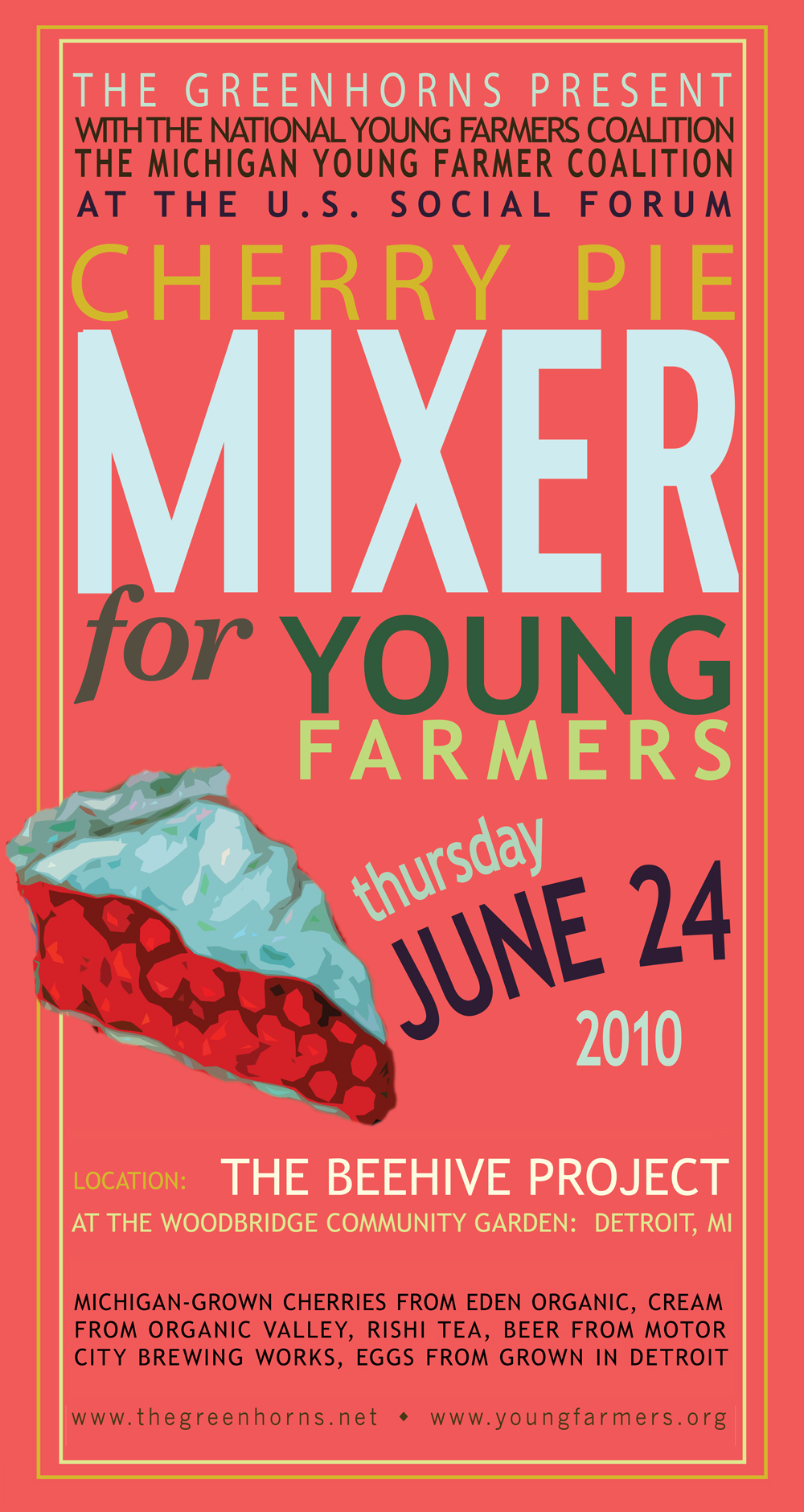
Flyer for the Cherry Pie Mixer.

Not completely garden-ed out for the day, we headed to the Young Farmer Cherry Pie Mixer organized by the Greenhorns at the Woodbridge Community Garden. And boy, was there cherry pie! So we mixed and mingled, pie in hand, with other young farmers and farm supporters, from Michigan and Missouri and Maine and California. I talked with one man who was in the mead-making business and thus decided to start harvesting his own honey, setting up hives across the city of Detroit. Before long, we were gathered together via bullhorn and given an introduction by Severine von Tscharner Fleming, documentarian and Greenhorn. Then Reverend Billy from the Church of Stop Shopping shouted us some proclamations about the revival of small agriculture in the face of overwhelming empire. Shortly thereafter, a keg of Motor City Brewing Works finest Ghettoblaster ale was tapped inside the up-and-coming art project of the Beehive Project, a “large-scale installation by an interdisciplinary community of artists and thinkers in Detroit” – not to be confused with the Beehive Collective, also awesome.

Reverend Billy preaching in front of the Beehive.

Tired and to bed.

Day Twelve:

BikeIt: Pedal to the USSF – Testimonials and Exploration of the Bicycle as a Tool for Social and Environmental Justice.

Welcome to the last day of thinking – for a while. Being a promoter of pedal-powered transit (even while in a skirt, transporting garden tools), I decided to buckle down with some bike riders. Two main bike contingencies shared their stories about biking to the US Social Forum. One from Ithaca, NY – covering 500 miles in 8 days. The other from Madison, WI – covering 300 miles in 8 days. Coordinated through the Bike-It Project, organized to promote biking alternatives and push both physical and mental limits. Each of the groups were followed by support vehicles – including the Permaculture Bus from Montana. Each made stops in communities to volunteer and build community within the collective through skill shares. Ages of bikers ranged from 9 to mid-70s. Bike collectives represented: Spoke ‘N Heart Collective (Atlanta), the Garlic Derailleurs (Chicago), the Grassroots Caravan (Madison) and the Petrol-free Gypsy Carnival Tour.

Saddle bag for bike made from refashioned kitty litter boxes - workshops lead by Petrol-free Gypsies.

Beyond sharing stories, we collectively identified issues and inhibitors of bicycles as the main form of transportation – as well as populations typically marginalized from biking communities. And brainstormed ways of making biking accessible to all, while building community and sharing skills while delving into the deeper topics of race and privilege. This is the beauty of the bike. To pass through new places and ponder the people and their stories.

We Agrarians gathered together for the rest of the afternoon to process yet we had learned – and what to do with all that stuff once we got back to our places of origin. This was also our farewell. Might I add that a number of our Road Trippers will be returning home to plant gardens and wear more plaid.

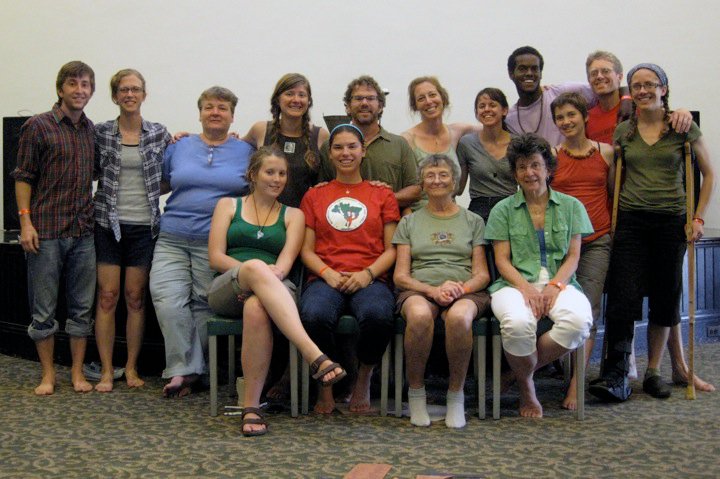
Road Tripper group photo on our last evening together.

Day Thirteen:

Already some of our group had disbanded before breakfast. The rest of us headed to Detroit’s famed Eastern Market for some good eats before hitting the road (watch the video of our trek through the Market). The Eastern Market has been in existence since 1891 – and currently is a common source for groceries for a number of residents in Detroit. While there are a fair share of resellers (all those “farmers” who sell produce with stickers on them), there were a plethora of local bakers, urban farmers, and cheese makers. Even a few Amish farmers who start their trek to Detroit at 2am every Saturday. I also located my honey man and bought a jar of his Wild Detroit Honey.

Getting a wee bit road weary at the Eastern Market.

Then we started on our road home. Or at least to Louisville. And that’s where my story ends.

Ready to hit the road for home.

End Day Thirteen. End Part Six.

Wednesday, June 30, 2010

Agrarian Road Trip: Part Two.

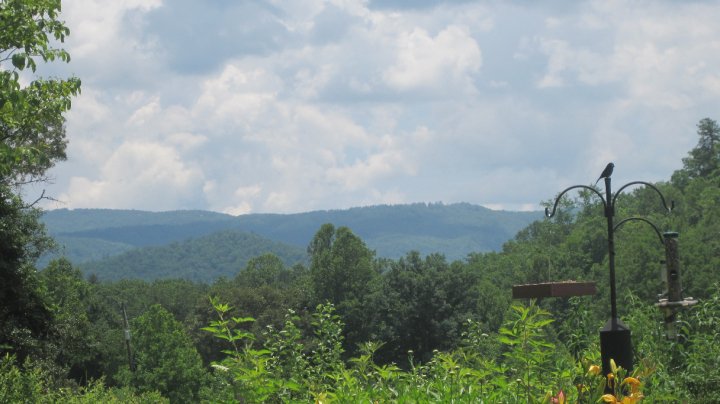
View of the Blue Ridge Mountains in Brevard, North Carolina.

Rural Revival:

the Agrarian Tour through North Carolina, with a nod to rural Virginia

On our venture into the Blue Ridge Mountains of North Carolina, we – Agrarian Road Trippers – encountered the ugly effects of war, tobacco, and child labor juxtaposed with and transformed into community-supporting small-scale agriculture

Day Four:

Lunchtime at the Bahnson Homestead.

Naked children running through a front yard sprinkler. The time is mid-day, lunchtime. We share a garden fresh meal of salad with o-so ripe tomatoes and water melon, as well as some hard boiled eggs from some hard-working chickens. Blue Ridge Mountains surrounding us in the valley. One of the biggest inhibitors for young folks – all folks – to start farming is land. Farming is one of the most capital-intensive careers – inhibitory during a time of economic crisis and in a society where agricultural life is dwindling in the shadow of Big Ag. However, we are in the Blue Ridge Mountains. In the midst of wilderness happening. Here we meet Fred and Elizabeth Bahnson – and their two little boys running through the sprinkler. Here outside Brevard, North Carolina, we are in the midst of this New Agrarian Movement. A revival of the rural. The Bahnsons may as well be the poster children for what the small family farm can be. Fred is a writer and student of the ways of permaculture. Elizabeth is a bluegrass fiddler with an interest in livestock. And they have been blessed with family land in the midst of the Blue Ridge Mountains.

the Bahnson Homestead in the Blue Ridge Mountains.

[Here is just a snippet of articles written by Fred: Compost for the Kingdom; A Garden Becomes a Protest; Monks, Mushrooms, and the Sacramental Nature of Everyday Eating; Good Soil.]

Trellised beans at the Bahnson's.

Where the Bahnsons live is actually a microclimate in the midst of the mountains – a tropical rainforest, receiving nearly 80 inches of rain each year – as much as Seattle. As they build their new house, the Bahnsons have planned to harvest the rainwater, situating their catchment system on top of a hill – to gravity-feed to their biointesive growing beds. In addition to rainwater catchment, Fred has designed swales on the contour of the land to irrigate native fruit trees and prevent erosion on the steep slope on which their farm is southerly-facing. Other highlights of their farm-to-be are living mulches that fix nitrogen (lupine) and accumulate other deep nutrients (comfrey), as well as growing their own grains (Hopi blue corn for grinding). Elizabeth is currently dreaming of a goat dairy.

Veterans Victory Garden.

After leaving the Bahson’s, we head towards Asheville to the Asheville Veterans Restoration Quarters – a converted Super 8 that now houses around 225 homeless veterans every night. Men who have served in all wars from Vietnam to Iraq are housed here – with an average of 51. By request of the men – and with incredible support of a visionary directory, one acre of land was converted into an organic garden to provide therapeutic activity as well as fresh food to the residents of the shelter. The Veterans Victory Garden was started in 2008 and now operates its own Tailgate Farmers Market two days a week. The men have also been able to take courses in gardening and greenhouse production to hone their expertise – as well as working with Master Gardeners to earn the art of canning and preserving. Money earned through sales to the community is supplemented with funding from Tobacco Settlements in North Carolina to sustain the financial success of the garden. Currently the two men maintaining the garden are seeking to become Certified Organic through the USDA. The social worker in me is encouraged to see projects that integrate the rebuilding of soil with the rebuilding of lives.

Edible flower salad with monarda and day lilies.

Our next stop takes us back into the mountains outside Asheville, to Warren Wilson College in Swannanoa, North Carolina. We begin our stay with a lesson in ethno-botany with Chef Marc Williams. Chef Marc guides us through the culinary uses of commonly found wild – and not so wild – edibles. Together we craft our dinner: herbal tea of monarda (bee balm), spearmint, sassafras leaves; pesto of lamb’s quarter and basil; garden salad with more lamb’s quarter and lettuce, garnished with day lilies and monarda; and for dessert, juneberry-blackberry cobbler.

The remainder of the evening is spend in conversation with folks from the Appalachian Sustainable Agriculture Project and Association of Farmworker Opportunity Program. The Appalachian Sustainable Agriculture Project (ASAP) started in the mid-1990s with Tobacco Settlement money to help transition farmers in the tobacco fields to organic vegetable production – as well as to build demand for local food. Currently, ASAP works on organizing and supporting farmers markets in the northwest region of North Carolina and working on farm-to-institution projects – such as connecting local farmers to the food services of schools, hospitals and colleges.

The Association of Farmworker Opportunity Program (AFOP) is focused on two main agricultural issues: pesticide outreach to farmworker and children in the fields. Our conversation focused on child labor in the fields. In North Carolina alone, over 150,000 migrants come to work the agricultural season – helping make agriculture the number one industry in North Carolina. However, an often overlooked issue of migrant labor is child labor out in the fields. The Child Labor Law in 1938 does not include limitations on child labor in agricultural fields. Many children are found in the fields helping their parents meet harvest quotas in order to earn enough to live on. As is the case, many students start the school year late and are pulled out before the school year ends – and often drop out before graduating. Beyond educational structure, children out in the field are exposed to pesticides, dangerous machinery and at-risk for muscular-skeletal injuries. Penalties for corporations and large farms caught with children in the field are little more than a slap on the wrist. Just one of many of the ugly truth behind our large-scale agriculture.

Day Five:

the Farms of Warren Wilson College in Swannanoa, North Carolina.

Warren Wilson College (WWC) is another crazy liberal arts colleges with a high emphasis on sustainablity. With just over 900 students – and growing, WWC receives increased interest each year in its Sustainable Agriculture and Sustainable Forestry Programs. WWC started in 1894 as a farm school for farm boys – but has expanded much beyond farming, and boys. When asked about the College’s rapport with the Swannanoa community, Sustainable Ag Professor Laura Lingenck tells us she finds locals frequently cruising through the campus, admiring the sight of young buff women not afraid to run a tiller or back hoe.

Students in the Ag Department operate both the Market Garden Farm and Grain and Livestock Production – a total of 150 acres in production. In the Market Garden Farm, garden beds are double-dug according to French intensive methods. Produce is grown for local markets (2/week) as well as a CSA in the summer months for faculty and staff of WWC. Much of the produce is also sold to WWC Dining Services, contracted with Sodexho. (WWC purchases 18% of its fruit and vegetables from its Market Garden and 50% of its red meat from the Livestock Program). Both cover crops and rotational planting are incorporated into the planting schedules, as well as hoop houses for season extension. Throughout the season, chickens in movable tractors are run through the garden beds, to fertilizer and control pests. The Sustainable Ag Program chooses not to certify its vegetables organic.

Little piggy: cute when little, food when big.

As for livestock management, the Sustainable Ag Program grows the majority of its own grains for animal feed – typically a profit-eating cost in livestock production. Stock-piling is another way the College conserves money, by allowing its cattle to graze grain still standing in the field even after the first frost. Approximately 175 cattle graze on a 25-paddock rotation – on perennial pastures of corn, alfalfa, oats, barley, and wheat. In addition to cattle, WWC also raises pigs, chickens (which follow the cattle in rotational pasturing) and horses for draft farming, mainly in the Agroforestry Department. Other department tractors (as well as maintenance vehicles on campus) run on locally brewed biodiesel, Blue Ridge Biodiesel.

Student building a cob structure for compost storage.

As if the Sustainable Ag Program at WWC weren’t great enough, the Recycling Department at WWC also features student-constructed industrial compost tumblers, a soon-to-be-built cob house structure, and Free Store to recycle unwanted clothing, furniture, and all other sorts of odds and ends with just a wee bit more life in them – or that can be refurbished at WWC’s woodworking and bike shops. We rough agrarians rummaged for a spare notebook, extra shampoo and souvenir t-shirt.

Before leaving North Carolina, we continued our rebelliously delicious and ridiculously fresh forays into food at Rosetta’s Kitchen in downtown Asheville. Rosetta’s features a number of vegetables and ingredients sourced from the Swannanoa Valley. I ordered the special of the day – pickled maroon and golden beets atop a bed of fresh greens atop fry bread, dressed with a cilantro-cashew sauce. Yum.

Blain enjoys his dinner at the Harvest Table Restaurant.

We hit the road for one more stop before our final destination in West Virginia. The Harvest Table Restaurant in Meadowview, VA, renowned for its connection to the author and sometimes agrarian essayist Barbara Kingsolver. Kingsolver’s husband, Steven Hopp, owns the Harvest Table Restaurant – and has crafted its menu to include food mainly sourced within 100 miles of the restaurant. Vegetables are a given, but the Harvest Table also sources meat, cheese, eggs and rice (grown in South Carolina) from the region. I ordered a caramelized red onion and beet green frittata and was greeted by the happiest, orangiest of eggs on my plate – a rarity in the dining-out world. Once again our minds – and taste buds – have been blown by the exhausting epicurean delights on which we dine. Oh the glories of local food!

the Agrarian Road Trippers at the Harvest Table Restaurant.

We are passively witnessing the reawakening of rural life. Her pastoral hillsides. Her setting sun to the lowing of cows. Her stars in the pure black night. We now have the responsibility to share the romance we see. To bring sexy back. Not only to rural living and lifestyles – but to agricultural vocation.

We are agrarians.

End Day Five. End Part Two.

Tuesday, May 11, 2010

Don't explode your brain

This post was originally published at Yellow Inkling.

I had a great discussion with our current Service Learning group about what can practically be done – by you and I - about poverty in this world. But wait – what’s a Service Learning group?

P4300855 At World Hunger Relief, we host several Service Learning groups a year. Part of the mission of the Farm is to “educate those with an economic abundance on methods of conserving and sharing resources.” Our Service Learning program, along with our fun-filled (and rabbit poop, worm, goat, chicken, garden-filled) Farm tours, and sending farmers off the Farm to speak, are ways we do this in our community. And...surprise! One of my main jobs here on the Farm is to manage all three of these education programs.

Our Service Learning groups come from schools, churches, families, and universities. They stay for varying lengths, from 8 hours up to two weeks. During Spring Break time (March-April) we are super busy with several Alternative Spring Break groups from colleges around the country.

Right now we have a National Summer Service Team from University of Michigan on the Farm. They’re one of our longer- staying groups just a day shy of two weeks. They’ve been an ideal group and I’ve really enjoyed getting to know them.

Last night I hosted one of my favorite Service Learning activities for them – Hunger Meal. The activity includes a meal, a presentation, and a discussion at the end. At the beginning, each participant chooses a life situation card. The card includes a name, country of residence, income bracket, and a short description of daily life – struggles, work, family, etc. Each participant is then fed according to the card they randomly picked.

I try to schedule this activity after a hard day’s work and the groups are asked not to snack between lunch and the activity which typically takes place during the evening. The “high-income” people are seated at the table with a ridiculous amount of food, usually including a balanced meal with meat, several beverage selections, and dessert. “Middle-income” participants are seated in a chair and are given beans and rice in a bowl with a spoon and a glass of water. “Low-income” participants are seated on the ground and given a large pot of rice to share amongst themselves, along with glasses of “dirty water” (water colored light brown with a splash of coffee or tea). It usually breaks down to about 15% of the group being high-income, 25% middle-income, and 60% low-income.

While the participants eat, they share their cards and I present current statistics and issues regarding world hunger and poverty.

In all honesty, although this is my favorite Service Learning activity to lead, it’s a difficult one. It’s difficult to talk about hunger and poverty in regards to statistics and generalities. In fact, in the past, I’ve often avoided talking about these problems because I didn’t know of a good way without mentioning the often sterile and meaningless statistics. But after first learning how to lead this activity I realized something – some people have never heard these statistics; they might know that there are hungry people in the world, but they don’t realize that it’s a sixth of earth’s population. I’ve learned that it’s okay to start with: currently, there are 1.6 billion people living on less than $2 a day – 900 million people in this world go hungry every day.

I say this to people who, at this point in the day, are very hungry themselves, given a handful of rice after a many hours of hard work. Then, I move closer to home – Texas is the second hungriest state in the Union – 15% of people living in Texas go hungry every day. After presenting the dry facts (that may be less dry with rumbling stomachs), I share what the Farm is doing and what they can do themselves. Last night we had a great discussion about this.

The issue was this: what can we practically do about poverty in the world? The problem is a big one and if we were to think about all the complexities at the same time and worry about and try to solve all of them, our heads would explode our pink brains everywhere. Instead, we discussed a few important steps. If you are wondering about what you can do, read on. This is what we came up with.

  1. Education – educate yourself about what’s going on. Familiarize yourself with some statistics. I told the group last night that they were in fact doing something about poverty and hunger by taking that first step: coming to the farm and learning about what’s going on in Waco, Texas, our country, and the world. You can start with our links. Quick intros like 12 Myths About World Hunger are also a good start.
  2. P3150781People – surround yourself with like-minded people, people who care about these issues and want to learn more, too. They don’t have to have the same ideas as you – in fact, the purpose of finding like-minded people is to learn from them and share perspectives, while also being encouraged. This was one of the reasons why I wanted to come to the Farm. These people are everywhere – your school, your church, maybe your family, your friends (exhibit A: the lovely specimens pictured above.) There may be groups near you that are already meeting and doing something (think Texas Hunger Initiative, McLennan County Hunger Coalition, Heart of Texas Urban Gardening Coalition, etc).
  3. Resources and Your One Thing – As people that live in America, we have to start looking at where we are putting our resources. This is often the hardest step. Even those who don’t consider themselves “rich” have enormous amounts of resources (money, time, influences). As we talked about this last step, we decided that the best way to handle this is to start small. Pick one part of your life to examine. A few years ago, when James and I first started looking specifically at the issue of hunger and how it relates to the food system, we decided to pick one thing to change.
P9100078 I started with my eggs. We eat a lot of eggs and I knew that most of the eggs sold in grocery stores were produced by chickens that were abused, pumped full of grain (which could be used elsewhere) and antibiotics, and cared for by people who are often abused themselves by employers. And so we concentrated on eggs: just finding a supplier for eggs that I knew, either through friends or the farmer’s market, or even getting a few of my own chickens. After we did that, we went on to milk, then meat. But we took it one thing at a time. And yes, sometimes that one thing took six months to solve, find, or incorporate into our lives. But since we did gradually, it didn’t make our brains go ka-boom-splat.

Maybe you drink an insane amount of coffee – maybe that could be your “one thing.” Take time and find out where your coffee comes from. With coffee being one of the biggest reasons why modern slavery exists, you could take some time and find a Fair Trade supplier or talk to your local coffee shop owner about serving Fair Trade coffee.

Fair trade net-logo Fair_Trade_Federation_Logo Transfair-usa-logo

So, go! I release you from this ridiculously long blog post. Go learn and educate – go find those like-minded people (come to the Farm!) – and find and start with your one thing.

Oh, and if you get stuck, drop us a line at the Farm.

(Maybe your thing is Vodka? Solved. Ha.)

Saturday, October 31, 2009

turkey.


turkeys are peculiar creatures. at the farm, we have the joy of herding the little ladies out to pasture on a daily basis where they happily feed on sunlight, grass and farm-fresh air. until thanksgiving rolls around.

rather than raising beautiful heritage breeds, we rely on the good graces of cargill, who graciously grace us with 100-odd turkey chicklings (poults), as well as donating their bedding and supplemental feed. thank you corporate kindness.

papa ghana: turkey man of the year 2008.

enough of my pastoral ponderings . . . and back to down and dirty farm life (note the farmers in charge of the farm's turkeys!). this morning, herdsman raymond mcgee/mcginnis small gathered and guided our friendly fowl to their pasture plot. like the dumb domesticated beasts that we all are, they were soon distracted (probably by some shiny object) and thundered full-speed in my general direction. if you've never seen a turkey run/waddle-at-full-speed, they rev their engines like turbo jets prepared for take-off but remain ground-bound due to their bountiful bosoms.
rodeo wrangler:
turkey man of the year 2009

well, in their great rush, only lovely lady got her dinosaur feet stuck in a mud puddle. and flap as she might - her flappage was all in vain (turkeys are suckers for pathetic deaths). i hopped the fence just as her scrawny neck went limp and her beady head turned blue. so i said a prayer - asked the great herdsman to carry her to the processing house for final rites. after a cup of coffee.

1. sharpen knife.


2. hang bird.


3. slit throat. (those americorps members can do everything!)


4. skin and eviscerate.

i am grateful to know the sunlight and air that nurture our food to life. to know the green pasture and garden soil that feed us. and to share the bounty with each other over a bonfire. rather than view death as the end, we see new life. i suppose there's a parable in there somewhere.

rather than think too much, we give thanks. and dream up new possibilities for something that could so easily have been discarded. i guess that's what the dream's all about. let's not waste it.