Showing posts with label Agriculture. Show all posts

Wednesday, August 4, 2010

Texas at the Table: Part Four.

Preservative Pickles, Cardboard Apples, and the Theology of Disposable Dishware

at the Table in San Antonio, TX

While surveying the sights in San Antonio, we – the lovely ladies of the Texas at the Table: Project Go Road Trip – experienced the full spectrum of emotion – from shock and awe, disillusionment and hope. We discovered new insights into everyday theology – through eating red delicious apples and washing mismatched dishes. San Antonio was the fourth stop on the Texas at the Table Road Trip to explore how people across Texas creatively address hunger in their communities – or more simply, exploring where food comes from, who gets it, and who doesn’t.

Day Ten: After basking in the sun for an afternoon and unwinding in a cabin in the hill country, we dove back into summer feeding frenzy in San Antonio. Our first stop was Baptist Temple Church to meet with Pastor Jorge Zayasbazan. Baptist Temple was one of the first churches in San Antonio to initiate a summer lunch program for neighborhood children. In their second summer, Baptist Temple now hosts summer camp five days a week, providing programming for kids all morning long and ending with a lunch. In San Antonio, the summer lunch program is sponsored by the San Antonio Food Bank to coordinate the food distributed to the various lunch sites across the city. Pastor Jorge led us through the kitchen to show us a bagged lunch prepared by the Food Bank – a hot dog wiener, pickle-in-a-pouch, fruit cocktail, and fruit cereal bar. If enough time and hands are available, the hot dogs will be heated up in the microwave before served to the children in a white bun. My fellow Road Trippers – already having their fill of hot dogs – were aghast at the nutritional deficiency of said meal. And yet such meals meet the US Department of Agriculture’s nutritional standards of a healthy meal.

the beautiful San Antonio Food Bank.

From Baptist Temple, we jumped in the cars, stuffed some carrots, cucumbers and hummus in our mouths and headed towards the San Antonio Food Bank to meet with Paco Velez, Director of Services – to take a tour of the city programs with which the Food Bank partners. First stop, a neighborhood center summer program for teens. This program was co-sponsored with HEB and Radio Disney. When we walked through the doors, we were hit with the smell of sweaty adolescence, or should I say, teen spirit. Radio Disney led dancing-jazzercise wonderful-ness with the teens. The HEB mascot handed out apples. The overall focus of the program is health and fitness. I spoiled the good vibes by politely declining the offer of an apple, because personally, I think red delicious apples taste like cardboard – and out of all the hundreds varieties of apples, I have no idea why we as a culture have adapted the red delicious apple as the apple of choice. If I were a teacher and a student of mine handed me a red delicious apple, I would promptly compost it. Perhaps this is a bit harsh, but food grown for artificial appearances preserved to have a shelf-life of 6 months should not be considered edible. Chemicals are used to keep the food-product looking fresh, while the sugar content (ie flavor) begins to deteriorate the moment it is plucked from the branch. This is not food. And this is why our children do not eat their vegetables. Or red delicious apples. Or fruit infused-in-high-fructose-corn-syrup cocktail. And also a contributing factor to the increasing rate of adult-onset diabetes and obesity amongst our children. Excuse my rant.

Teen Center partnering with San Antonio Food Bank.

After the youth center, Paco took us to a senior center distributing senior food boxes in addition to what the social worker side of me chooses to refer to as the diabetes line – donations from HEB of all the day-old pastries, cakes, cookies, breads. Don’t get me wrong – I truly appreciate attempts to salvage food from waste (and am an avid dumpster diver of groceries and used to rescue hundreds of $$$ worth of fresh produce from my local Trader Joe’s) – however, as a former case manager for low-income and homeless families, it pains me to see people who have lost their sight, toes, or whole legs to diabetes reaching for that free cake donated by HEB. Let them eat cake, indeed! If we want to adequately fix our broken health care system while attempting to end hunger in our communities, we must understand and emphasize the importance of good nutritious food. A shift must occur socially and culturally. Those of us from higher economic brackets who prefer fresh organic food – be it from HEB, Central Market or Whole Foods – musn’t reach for the can of creamed corn and bag of ramen noodles that we wouldn’t feed ourselves or our children when the next food drive for the church food pantry hits us in the face. If we have respect for our own bodies and own health – as well as that of our children – then as Christians (if we claim to believe in God and the words Jesus said to love our neighbors as ourselves) we must also respect the health and well-being of our brothers and sisters we serve at food pantries, on the street, at work, next door. Excuse my rant.

Filling a food box at a senior center.

Next stop: one of the Food Bank’s drive-thru food box distribution sites. Typically the Food Bank requires that a parking lot can accommodate 500 cars in order to qualify as a site. The site is complete with canopies covering everything from potatoes to beverages to rice and more is hand-loaded by Food Bank employees into the trunks and backseats of those willing to sit idling in the parking lot. Qualifications: folks must have a child under 18, call ahead to the Food Bank to reserve a box, and be willing to take the time in the morning or afternoon to wait in line. Such a food distribution presupposes transportation and gas money.

Drive-thru food box distribution.

Our last stop before heading back to the Food Bank was the infamous Haven for Hope, a multi-million dollar response to homelessness in San Angelo. As our friend Steven from Austin explained, Haven for Hope is the Walmart of the social service world: one stop shopping for the homelessness community, providing a multitude of programs and gated community setting – and slowing putting smaller homeless assistance programs out of business with the consolidation of funding and services focused on Haven for Hope. The Food Bank’s role at Haven for Hope is food, of course, as well as a Culinary Arts Training Program – allowing residents to participate in a job-readiness program. We benefited from some of the program’s red velvet cake.

Looking at aspargus at the Food Bank Garden.

Finally, the Food Bank operates a garden on the site of the main headquarters. I led the gals for a plant identification tour – testing their increased knowledge of various vegetables and herbs. Upon asking Paco about the Food Bank’s sourcing of fresh produce, he told me they work with one of the largest produce warehouses in the state of Texas – which donates millions of pounds of vegetables and fruit each year. The Food Bank also encourages community partners to start their own gardens, providing seeds and tools to help get their gardens started.

the Lovely Ladies with Paco.

That evening we had a terrifying experience had an HEB-plus on the south side of the city. I would also like to comment that any and all of my rants are not against the San Antonio Food Bank specifically. The SAFB is one of the best food banks in the nation, distributing large amounts of food to those in their community who need that extra support. They do good work. However, I am continually frustrated when efforts to address hunger in the community are haphazardly bandaged through quick fixes of food-products devoid of nutritional value – while the plight of the family farmer is furthered by our societal reliance upon agri-business and corporate conglomeration of our food system. Seems like there should be a solution in there some where to connect the idea of growing food with the issue of ending hunger, while economically benefiting small growers and the local community at the same time . . . Excuse my rant.


Day Eleven: Friday morning our view of San Antonio – and the entire trip – shifted. Rather than continuing to see refined programs tailored to look good in funding pamphlets, we saw down and dirty service to community. We metwith Dee Sanchez, volunteer at the San Antonio Catholic Worker House – who, first things first, led us in a devotion centered on Matthew 25, integrating Jesus’ message into the work of the Catholic Worker house – feeding the hunger, providing shelter to the homeless, doing laundry, sharing conversation, sharing coffee, etc. The Catholic Worker Movement started many moons ago when a fiesty young woman – Dorothy Day – and simple agrarian-minded man – Peter Maurin – frustrated by the Church, decided to become the hands and feet of Christ through inner-city and agricultural hospitality. Today many Catholic Worker Houses are scattered across the country, continuing in the fiesty agrarian spirit of Dorothy and Peter. We Road Trippers truly felt that all who entered this old house were truly welcome. We spent the morning in the crowded kitchen of the house preparing lunch for whomever might show up. Potatoes were chopped, boiled and mashed. Donations of meat from a local rib joint were brought in. Herbs gathered from the garden. Vegetables chopped for salad. Peaches prepped for peach cobbler. Men wandered in and out, grabbing a hot cup of coffee on this 100-plus degree day. Folks came in to sign up for the laundry list. Some wanted to look through the clothing closet. Others volunteered to wash dishes. All was chaos – clanging of plates, swapping of stories – 50 at one time, sweaty bodies huddled over the chopping block. And yet through the chaos of it all – we loved it. Rather than receive food and donations from the San Antonio Food Bank or applying for government funding, the Catholic Worker House relies on donations from charitable folks in the community, praying God will provide day by day.

the San Antonio Catholic Worker House.

While preparing the meal, we heard stories of people on the streets. Some struggling to get into Haven for Hope and expressing their frustration with the lack of transparency of the program. Neither of the two claimed to do drugs, struggle with alcohol or have a history of abuse – which are key issues for getting a bed quickly at Haven for Hope. Rather they are the in-betweens, sleeping outside huddled against the building. They are allowed to take showers – but the stalls are only half-height and the toilets have no doors. Lunch is a cold sandwich in a brown bag. This couple has fallen through the cracks, like many other folks we meet – and this is where the Catholic Worker House opens its doors. For those who fall through the cracks. A hot meal is provided – with mashed potatoes, made from real potatoes, not off-brand flakes. And the dishes are real, not disposable. Another pet peeve of mine – disposable dishes. And not for the eco-elite reason of not being environmentally sustainable – but because of dignity. You would wash dishes for your family . . . If we serve people disposable food on disposable dishes, soon people begin to understand themselves as disposable people.

We served over 100 people for lunch that day – without air conditioning, without a dishwashing machine, without the Food Bank, without the government. As Dee said, “Love in Reality is a harsh and dreadful thing as compared to the Love in Dreams.” After cleaning up, we were plumb tuckered out and went back to our apartment at Baptist University of the Americas – and order a pizza from our local Pizza Hut . . .

Pearl Brewery Farmers Market.

Day Twelve: A more relaxed day. Drove to the Farmers Market at Pearl Brewery, where we bought some vegetables, sniffed some lavender, and browsed some books. Then we traipsed through Whole Foods – a first for the gals. So I gave them my Whole Foods plan of action – walk the perimeter and look for free food samples; walk the interior for free food samples; and walk the perimeter once more for free food samples. I also pointed out the Diva Cup – which I won’t get into here – but I had already given my 2-cents worth about being more sustainable during that time of the month. We ate lunch at Whole Foods before the gals scampered off to play sand volleyball in the scorching hot sun, with the two German Brethren volunteers we met at the Catholic worker house the day prior. Then we met up for dinner at Casa Rio and perused the River Walk, on the prowl for adventure. Finding none, we went home for a good night’s sleep before our drive to the Valley.

the San Antonio Riverwalk.

End Day Twelve. End Part Four.

Thursday, July 29, 2010

Texas at the Table: Part Two.

the Birds, the Bees and the Apple Trees

at the Table in Lubbock, TX

Having an initial crash course in Waco about the complexity of our food system, we – the lovely ladies of the Texas at the Table: Project Go Road Trip – made a bee-line for Lubbock to learn about (food) banks, bees, and Baptists. Lubbock was the second stop on the Texas at the Table Road Trip to explore how people across Texas creatively address hunger in their communities – or more simply, exploring where food comes from, who gets it, and who doesn’t.

Outside Steve's Market and Deli. Brownwood, TX.

Day Three: Beginning our trek from the World Hunger Relief Farm in Waco, TX, we head to our second destination on the Texas at the Table Road Trip – Lubbock – and the “road” part of our trip commences. Happily loaded into our Ford Fusions, we start our journey for lunch in Brownwood, TX – home of Howard Payne University, college of one of our fine young ladies, as well as Steve’s Market and Deli. Steve’s is an unusual little nook for small town Texas – more akin to Austin eateries – and we happily welcome Dr. Bronners soap and vegetarian fare wherever we go. Or at least I do – the gals were probably just weirded out. But here at Steve’s we also meet a wonderful woman who works with Keep Brownwood Beautiful and oversees the Brownwood Community Garden. The garden is funded through economic stimulus money, complete with in-ground irrigation and rainwater catchment, and sits on the back property of Salvation Army.

Inside Steve's.

After lunch, we take to the road once again to arrive in Lubbock and meet our hostesses – Vangela and Tish and the wee little Connor. Over dinner, we co-mingle with folks from the South Plains Food Bank – where Vangela works. Then one final stop before heading home to Vanela’s – the library. The library is a notorious sleeping spot for many of the homeless in Lubbock. We drop off extra food from our dinner to the men sleeping under the overhang. I met a recovering hippie named Woodstock who sleeps at the library when he can’t find a ride home. We part ways as it begins to rain.

the beautiful front facade of the South Plains Food Bank.

Day Four: Another bright and early morning. Heading to Kitchen of Hope, a project of the South Plains Food Bank, where many of the meals are prepared for the various Kid’s Cafe sites – an after-school snack and meal program for low-income kids sponsored through Feeding America, the national network of food banks. Kid’s Cafe in Lubbock also sponsors the summer lunch program. Next, we visit the Church of Jesus Christ of Latter Day Saints in Lubbock, as they are hosting a youth summer camp for LDS teenagers in the area. We watch a film about the commitment to service in the church in response to the Gospel. Then Vangela shares her story, being a single-parent of a special needs child, losing her job, and needing the support of the Food Bank in tough times. Now she is able to give back. And so can these kids. They are spending their morning going door-to-door to collect canned goods for the Food Bank. Originally the kids were going to volunteer at the Food Bank, but due to a shortage, there isn’t enough food for volunteers to organize.

Looking at flood damage at the GRUB farm.

From the LDS church we head to the GRUB Farm, another project of the South Plains Food Bank, where we did some flood-damage control, after the recent hurricane rains. GRUB stands for Growing Recruits in Urban Business – a youth entrepreneurial agriculture program to train young folks how to grow fresh fruit and vegetables – 50% of which is distributed through the Food Bank, while the remainder is sold through a CSA. Local students who participate in the GRUB program also sell produce at local farmers markets. After the GRUB Farm had been in operation for a few years, a survey was conducted to assess whether the program was benefiting the lives of the youth who participated. Much to the amazement of those in charge, the youth knew how to grow vegetables but had no idea how to eat them. Thus started another important component of the GRUB program – cooking lessons as well as other value-added programs. The kids also sell GRUB Scrub, loofah soap that they have grown and made themselves. The GRUB Farm receives agricultural and technical support from Texas Tech – professors and students conduct experiments with season extension and vegetable varieties, which are then integrated into the GRUB program. Because so many youth work at the Farm, the site also participates in the summer meal program.

GRUB mobile market trailer - built by Texas Tech students.

For lunch, we head to the main location of the South Plains Food Bank. Kitchen staff have prepared us a gourmet meal from food bank food – and we dine in elegance along many higher ups of the food bank – including the executive director David Weaver, who shares many stories of the people he encounters visiting the food bank. Meagan, who oversees volunteers, leads us on a tour of the Food Bank warehouse – showing us typical food boxes of dry goods, refrigerated goods, and fresh produce. The South Plains Food Bank is unique in that rather than distributing food to various social service agencies (which in turn distribute the food through direct social service) throughout the city, food is directly dispersed through the main food bank location. This poses problems in transportation – because the warehouse is located outside of town and bus access is severely limited.

Apple Country Orchards, Idalou, TX.

With hearts heavy and bellies full, we head out towards Idalou, TX, to fulfill a life-long dream of Mallory’s – picking apples. We drop in announced to visit Cal at Apple Country Orchards, for an afternoon of apple-pickin’. City girls picking apples. Cal is patient and polite with us. Even entertaining us afterwards with some German Apple Cake as well as some of his cotton honey – and stories of bees and children. He tells us of his struggles to educate children about where their food comes from – a project made tougher by the presence of parents, who are quick to nay-say the yumminess of an Early Blaze apple or Armenian cucumber (a new found favorite amongst Road Trippers). In order to subvert the minds of little ones, he separates the little ones from their parents and has them eat. And the taste tells the rest of the story. That and Cal’s demonstrations of bee pollination, buzzing merrily amongst fruiting flowers. He charmed us too with his tales of bee life and raw honey.

Mallory, living the dream.

Thanks to the overabundant hospitality of Vangela and Tish, we went back to their home for a dinner (at this point I should say that the majority of our meals were prepared and provided by the Food Bank kitchen staff). Then an evening on the town at a local coffee shop called Sugar Brown’s Coffee, where we made a new friend who happened to be a magician.

the Downtown Art Market - or DAM for short.

Day Five: A Saturday. Finally a weekend and some time for rest. Although, my – Bethel’s idea of rest seems to be vastly different than the rest of the gal’s. I prefer to sleep in until 8am. On a Saturday. Especially when there’s a farmers market to be gotten to. And so I rallied the ladies – much to their chagrin – and all headed to the Downtown Art Market. Random fact: Buddy Holly was from Lubbock. At the Downtown Art Market, we found vendors of all varieties, including: a lady named Emma who makes salsa (which we bought), many a jewelry maker, GRUB farm kids, Apple Country Orchard folks

(also bought some Armenian cucumbers and red raspberry preserves), and two lovely ladies making soap with wonderfully creative “flavors” like Ziegenbock.

Spanky's - 'nuf said.

Lunch was paradoxically taken at a local favorite, Spanky’s. Our meal consisted of fried mushrooms, fried okra, fried cheese, and French fries. Hey, some times you gotta keep it real. We ended our evening in style swimming in a gated community and dessert in a hot tub. At the home of the Food Bank’s executive director. There was also a deeply stimulating conversation concerning which ice cream flavors best embody the spirit of each Road Tripper. Example: Mallory – Blue Bell’s Birth Day Cake; Bethel – a mash-up of Homestead Heritage‘s Sorghum Pecan with homemade goat’s milk ice cream. Much sleep needed.

at Second Baptist, with Pastor Ryon and Pastor Ben.

Day Six: Egg breakfast, complements of the Food Bank. Love infused into the eggs, complements of Tish. Worship at Second Baptist – church of Vangela and David. Us gals split up into two groups to speak at the college and Boomers Sunday school classes. Then we worship with Harry Potter – actual name Ryon Price, a graduate of Duke Divinity School and new pastor at 2nd B. Sermon entitled “Like A Good Neighbor” – not referring to State Farm Insurance, but rather reflections on the story of the Good Samaritan. Pondering the question who is my neighbor, but on a deeper level, for the question asked to Jesus implies that certainly they are people who are not considered to be my neighbor. There are people that we need not be concerned for. There are people who are not considered to be my brother or my sister. But Jesus answers the tax collectors question with a parable-infused question – in typical Jesus-fashion. A good teaching as we take to the road again – and attempt to understand on this trip, deemed a mission trip, that ministry is not just confined to the few moments we haughtily choose to deem as missional.

End Day Five 1/2. End Part Two.

Tuesday, July 27, 2010

Texas at the Table: Part One.

And So it Begins, with Five Fearless Feather-Pluckin’ Females:

at the Table in Waco, TX

Whilst in Waco, we – the lovely ladies of the Texas at the Table: Project Go Road Trip – harvested and gleaned both vegetables and stories with dirty-fingernail-ed farm-hands and business-suited theological-thinkers. Waco is the first stop on the Texas at the Table Road Trip to explore how people across Texas creatively address hunger in their communities – or more simply, exploring where food comes from, who gets it, and who doesn’t.

the World Hunger Relief Farm.

Day 0.5 (the evening of our first gathering – thus not the legitimate Day One in my play-book): The much arrival happens. Five fearless ladies convene – with parental units – on the World Hunger Relief Farm in Waco, TX. The parents step out of their comfortably AC-ed vehicles to be hit brazenly in the face by the Farm – the heat, the smell. Welcome. The gals are starting to question what they’ve gotten themselves into. And perhaps, so are their leaders. All meet and greet each other awkwardly. A short tour of the Farm is given – complete with instructions that this is a flush-free farm (only composting toilets) and the home they will be staying in does not have running water or electricity. Parents leave reluctantly – they have left their daughters to the care of a lady with a lip-loop and nose-ring and the other one has tattoos . . . Introductory awkwardness subsides and its dinnertime. Except that dinner must first be harvested. Kale. Swiss chard. Onions. Peppers. (Supplemented with Bethel’s peanut sauce and rice). This dinner is a strange experience (in addition to the heat and composting toilets) because: 1. These gals never really cook; and 2. They don’t ever really eat vegetables. Whataburger seems to be a staple dinner. Bethel (the leader with tattoos and braids – and also the leader with tattoos) begins to worry . . .

Sunflowers for CSA harvest at the World Hunger Relief Farm.

Day One: No rest for the weary – or the farmer. Devotions at the Farm start at 7am. Lucas Land -Truett grad and former Farm intern – leads a discussion of personal heresies and the Bible. Work chores are handed out. Most farm folks are working the CSA (Community Supported Agriculture) harvest – the Farm supplies 60 families in the Waco-area with a week’s worth of fresh vegetables for 8 months a year, on a subscription basis. CSA is just one model of direct-to-consumer farm marketing allowing farmers to know that what is planted has a home once out of the field, creating a relationship between farmers and those who eat the food the farmer grows. All that to say, the Go Now-ers jumped into harvesting bouquets of basil, counting cucumbers and eventually bundling sunflowers for shares. After moving the chickens in their portable coop-mobiles, designed to rotate the chickens to fresh pasture – which leads to eggs richer in beta-carotene and omega 3 and 6 fats, all part of a healthy, balanced diet. After a farm-family lunch, Farmer Jes talked with the gals about raw milk as the gals washed eggs freshly collected from our clucking lady-friends. The Farm manages a Grade A Raw Goat Milk dairy – containing the healthy bacteria that aids in digestion for even those who are lactose-intolerant.

the Lorena stove over which our meal was cooked.

Without a siesta, the real work for the day begins. Making dinner. From scratch. Over a wood-burning Lorena stove. Without running water. With meat that must be caught and killed before eaten. This is no simple task for five young ladies not used to cooking, let alone with modern day appliances – and in the heat of the day. Two roosters were caught by Dani and Chelsea, who were brave enough to volunteer for the slaughter.

An education in chicken butchering with farmers Lucas and Bethel.

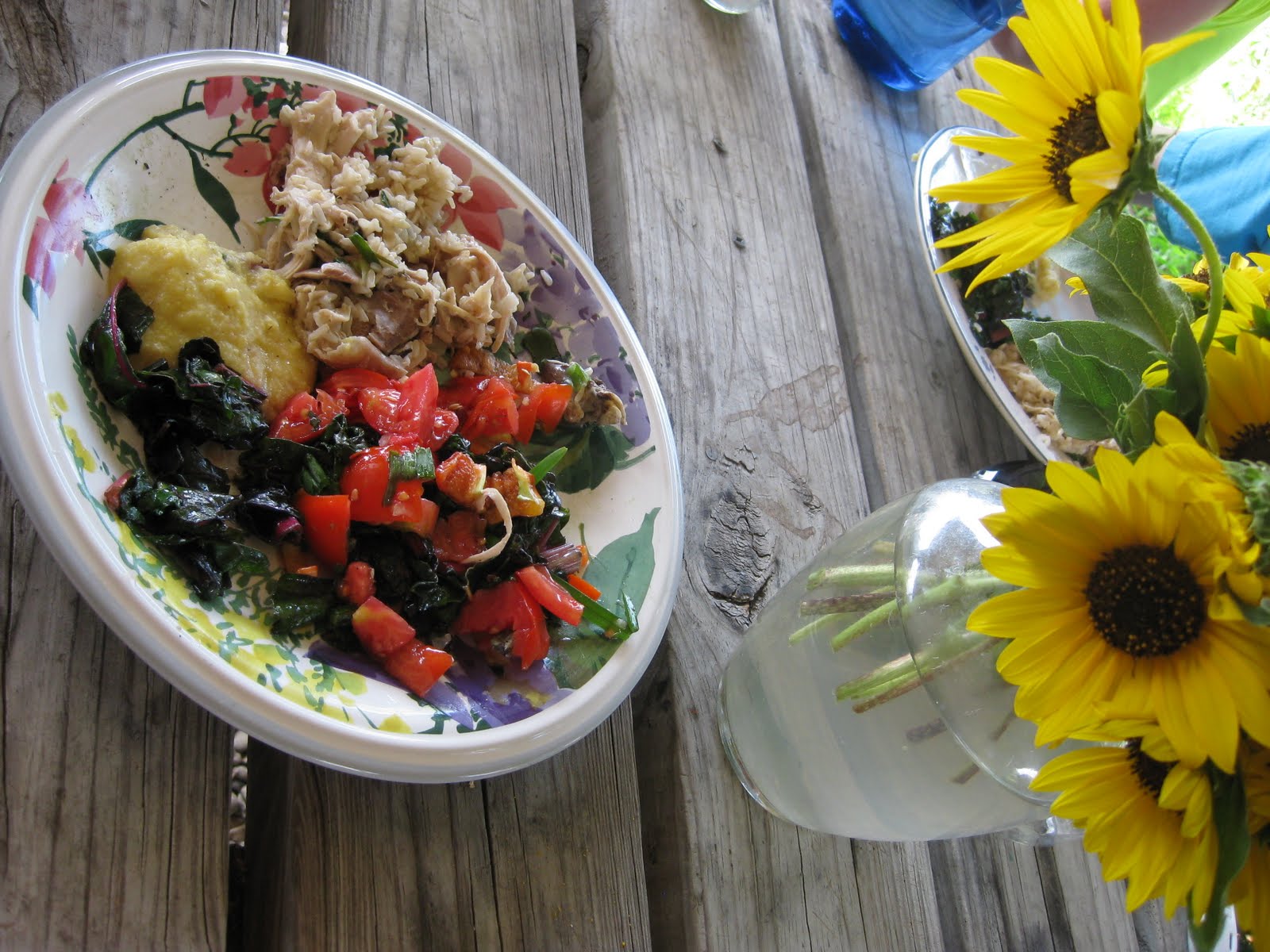
Necks were slit (albeit with a dull knife) and the birds were bled out and plucked, while the rest of the gals gathered garden vegetables and pumped water from a well. Four hours later, a simple meal of chicken and rice with greens was prepared and placed on the table for all to eat. Delicious to all except those still smelling chicken feathers beneath their nails. With bellies brimming with fresh eats and tasty meats, the gals ended their evening with a showing of Food, Inc. – posing even more questions in already wearied and worried minds.

Our made-from-scratch meal at the Farm.

Day Two: Rising with the sun in time for devotions at the Farm, all are a bit slower than Day One. Yet the gals are able to drag themselves to a meeting with Beth Kilpatrick and Jeremy Everett of the Texas Hunger Initiative – aiming to end hunger in Texas by 2015 through collaborative community organizing. Jeremy shared about the role of grassroots organizing hand-in-hand with political advocacy in ending hunger in communities – while highlighting Gospel passages to inform the work we do. Beth also shared a clip from Rush Limbaugh and his comments about the federal Summer Feeding Program which provides a free meal to youth ages 18 and under, covering the gap in the free and reduced lunch program that continues throughout the school year. Please listen to the clip – and share your own comments.

Summer meal site in East Waco.

After those parting words from Rush, Jeremy and Beth, we ventured to Wesley United Methodist Church in East Waco to experience a summer feeding site firsthand. We met with Reverend Valda Jean Combs and a representative from the Waco ISD Nutrition Program. Waco is a unique place when it comes to summer feeding – Waco ISD writes the program into the budget, ensuring that a number of trained cafeteria workers are employed throughout summer to deliver hot meals to the summer feeding sites throughout the city. Host sites need only open their doors. Wesley UMC is unique in that Reverend Valda has organized a summer day camp in addition to providing transportation to the church. In an effort to encourage families to eat together, the McLennan County Hunger Coalition subsidizes adults to eat with their children.

Hot lunch provided by Waco ISD at Summer Feeding Site.

From Wesley UMC, we met with Phylixcia Moore and her uncle Vernon Clark to discuss the role of urban agriculture in providing healthy, nutritious food in communities experiencing supermarket redlining as well as increased rates of diabetes, heart disease and high blood pressure. Phylixcia is now a sophomore at Prairie View A&M studying agriculture. While in high school, she headed the garden at Carver Park Baptist Church in East Waco, selling produce to the church for community meals as well as donating to food pantries. After Phylixcia had shared her story, her uncle Vernon asked a large question of the Go Now gals: How is the work you are doing and seeing maintaining poverty or attempting to resolve it? This question helped frame a number of the projects we were to encounter on the road.

From East Waco, we trekked to a variety of gardens throughout Waco – at churches and at schools – as I, Bethel, shared about my work as an agrarian social worker with the Heart of Texas Urban Gardening Coalition. We stopped at Homestead Heritage, another Christian farm in the area, for ice cream (my favorite being sorghum pecan) before heading back to the Farm to make pizza with farm fresh ingredients and resting before hitting the road to Lubbock.

Making pesto for pizza with fresh-gathered basil.

End Day Two. End Part One.

Friday, July 16, 2010

young farmer cherry pie mixer.

here is a video of a gathering of young farmers in detroit - hosted by the greenhorns and the michigan young farmers coalition - featuring three former farm-ies: patrick, darren and bethel - and some of our other young farmer friends.

Monday, July 5, 2010

Agrarian RoadTrip: Part Six.

Sharing Our Stories over Cherry Pie, Blueberries and Beer:

the Agrarian Tour at the 2010 US Social Forum

In this our final leg of the journey, we – Agrarian Road Trippers – shared many a story with many an agrarian minded folk in Detroit – locals as well as way-faring strangers flocking to the US Social Forum – to prove “Another World is Possible, Another US is Necessary, and Another Detroit is Happening.”

Day Ten:

Headed towards our workshop.

“Faith Communities in the Local Food Movement: Sustainable and Just!” – this is the culmination of our wayward travelings on the road. A workshop at the US Social Forum, by us. One of thousands. And close to a hundred other workshops happening at the same time as ours, including: “The Coalition of Imokalee Workers: Fighting for Fair Food” and “Re-Purposing Auto Factories to Manufacture Renewable Energy Infrastructure” and “How to Start a Raging Grannies Group.” With over 17,000 people expected to be in attendance, how were we to compete against Raging Grannies? We set our expectations low – maybe four people will show. If we’re lucky, the crowd will outnumber us presenters (15). Thankfully, the good Lord provided, and we hosted a crowd near 60.

Recruiting participants for our workshop.

Andrew (organizer for the Presbyterian Hunger Program – and our fearless leader) introduced our tour with the aid of Blain, morphing into a tale of our trip across eight states led by Kate. Three gals (Amy, Laura, and yours truly) shared a testimony of the work we are doing at home, connecting the realms of faith and food justice. Then we split into small groups to learn about the good work of those so politely listening to our journeys. To emphasize the faith component of our time on the road, Talitha expounded upon our beloved passage from Exodus 16, first shared with us by Ellen Davis back in Louisville, before we calmed our minds for a sacred eating reflection. Jud passed around blueberries, asking us to think of all the people who came into contact with this blueberry before it finally reached us. The farmworker, truck driver, grocery store employee, cashier, Monsanto madman, etc. Then we closed our eyes, thinking about the life of just one of those people, while savoring all the flavors of that one blueberry. We opened our eyes to share our experiences and continue our fellowship, sharing how we want to be involved in our food systems back home – and help our faith communities with our food systems.

Not everyone was a Christian. Not everyone was connected to their food systems. But that was the beauty of our communion together. We just set aside a little time to share a sacred meal. Together.

By Any Greens Necessary: Food as a Tool of Colonization and Joining the Resistance

This is the first workshop I attended. Intense. Hosted by Jade Walker, farmer from Mill Creek Urban Farm, and Chris Bolden-Newsome, farm educator at King High, both in West Philadelphia. Led our discussion about the struggles and movements of indigenous people throughout history for food sovereignty. We split into groups to discuss: Black Panther free breakfast program (before the USDA), Native American fry bread as example of dominate culture becoming sacred, Cochabamba Water War over the privatization of water in Bolivia, Landless Farmworkers Movement in Brazil to reclaim the commons for the benefit of all, and so many more. My group discussed the Zapatistas as reaction to the NAFTA signing in 1994 – and its impact on Mexico. A man from Mexico was in my group – and shared from personal experience how the trade agreement affected his family, farming and flight to the US.

Farmers fighting back, the MST - Landless Workers Movement - in Brazil.

We discussed organizing tactics – and the basic fact that WE ARE ONLY LIMITED BY OUR IMAGINATIONS! That the struggle for food sovereignty is still happening. As Jade said, “Colonization is not over. Sometimes it looks like gentrification. Sometimes it looks like limited access to resources.” As we continued to delve deep into these struggles, we were faced with our own stories – the stories of our people, the stories of our connection to the land. Our stories are our resistance to a culture that wants us to accept French fries as food, television as community. Our stories must be shared.

Re-Localization and the Role of the Rustbelt.

Next, hanging out with the Michigan Young Farmers Coalition to hear about some of their young farmer stuff. Gardens. Farms. Animals. Hoop Houses. Hoorah! One particular project – the Haven Garden Project - was started by a Michigan State Ag student with a womens shelter in Pontiac, MI, using permaculture methods and the resources of MSU’s greenhouses and other resources. The shelter serves 15,000 women each year. Limited access to fresh food in the community. Growing food for the shelter on 1/5 acre – improving the soil with compost to build raised beds. Surplus goes to a food pantry. Starting a relationship with a local chef to teach the women what to do with the food they grow.

After another day of food and farming, I was burnout. So my new Agrarian friends and an old farm buddy met up for a taste of the local culture at Motor City Brewing Works, a local microbrewing specializing in handcrafted ales and o-so delicious pizza. (Darren’s favorite: Mary-Had-A-Little, topped with roasted lamb!) Then to rest for another full day.

Day Eleven:

Ending Mountaintop Removal

My first workshop was canceled – with two very large, armed men standing outside the entrance. So I made my way to another workshop, led by the Rainforest Action Network. Because of our visit to Mullens, WV, communities living in coal country have now caught my attention. So I thought I would attend and not start trouble with the large, armed men. Activists convened to hear the story of one woman who has lived life, not in coal country, but in a community where the coal industry has decided to mine: “We don’t live where they mine coal; they mine coal where we live.” Her husband worked for the coal industry for 35 years, before dying of Black Lung. Now she feels she has no choice but to speak against the industry that has made her home Ground Zero for coal excavation. She expounded on the millions of pounds of ammonium nitrate used everyday to blow the tops off mountains – the same ingredients Timothy McVeigh used for the Oklahoma City Bombing. “When it happened in Oklahoma City, it was a tragedy. When it happens in Appalachia, it’s called progress.”

Coal: the tension between activism and the economy.

Of course, the solution to mountaintop removal is not clean cut. Communities may be 100% against mountaintop removal while being 100% dependent on coal for energy. Another tension arises between activists wanting an end to the use of coal vs. communities that are dependent on coal for employment – an issue that became apparent at the workshop.

Regarding health and environmental quality, the people of Appalachia have nothing to lose, and everything to gain. But their story needs to reach beyond the hills and the hollers, into a larger forum. Only 8% of the coal that the US uses for energy is sourced from the Appalachian Mountain region, with the rest strip-mined from western plains regions. Yet, Appalachia has the most dense population of all regions where coal is sourced – thus making mountaintop removal the low-hanging fruit in our nation’s transition away from dependence on coal.

After almost ending mountaintop removal, I headed to a wonderful little street a few blocks away from Wayne State University, where many a local business thrived. Lunch was supplied by the wonderful hands of workers at Avalon International Breads and Goodwells. Then I bought the latest book by Gayla Trail, called Grow Great Grub: Organic Food from Small Spaces at an independent bookstore, part of the Spiral Collective.

Reclaimed house (one of many) at the Heidelberg Project.

After lunch, I joined a few friends to visit some Detroit hot-spots. First, the Heidelberg Project. An avant-garde art project, reclaiming a few blocks in Detroit – houses and all – into a massive waste-infused piece of art. Reflecting on themes such as stories told in taxis, created in God’s image, and many more subtle-ly overt political messages – a pink hummer buried in the ground, sprouting flowers.

Code Pink Hummer at Heidelberg Project.

Next stop, Earthworks Farm. Started by Capuchin monks to provide food for a neighborhood soup kitchen. Also providing seeds and plants for community gardens throughout the city, as coordinated by the Greening of Detroit. My favorite part: the Compost Monster, resembling the Loch Ness monster atop a huge heap o’ compost.

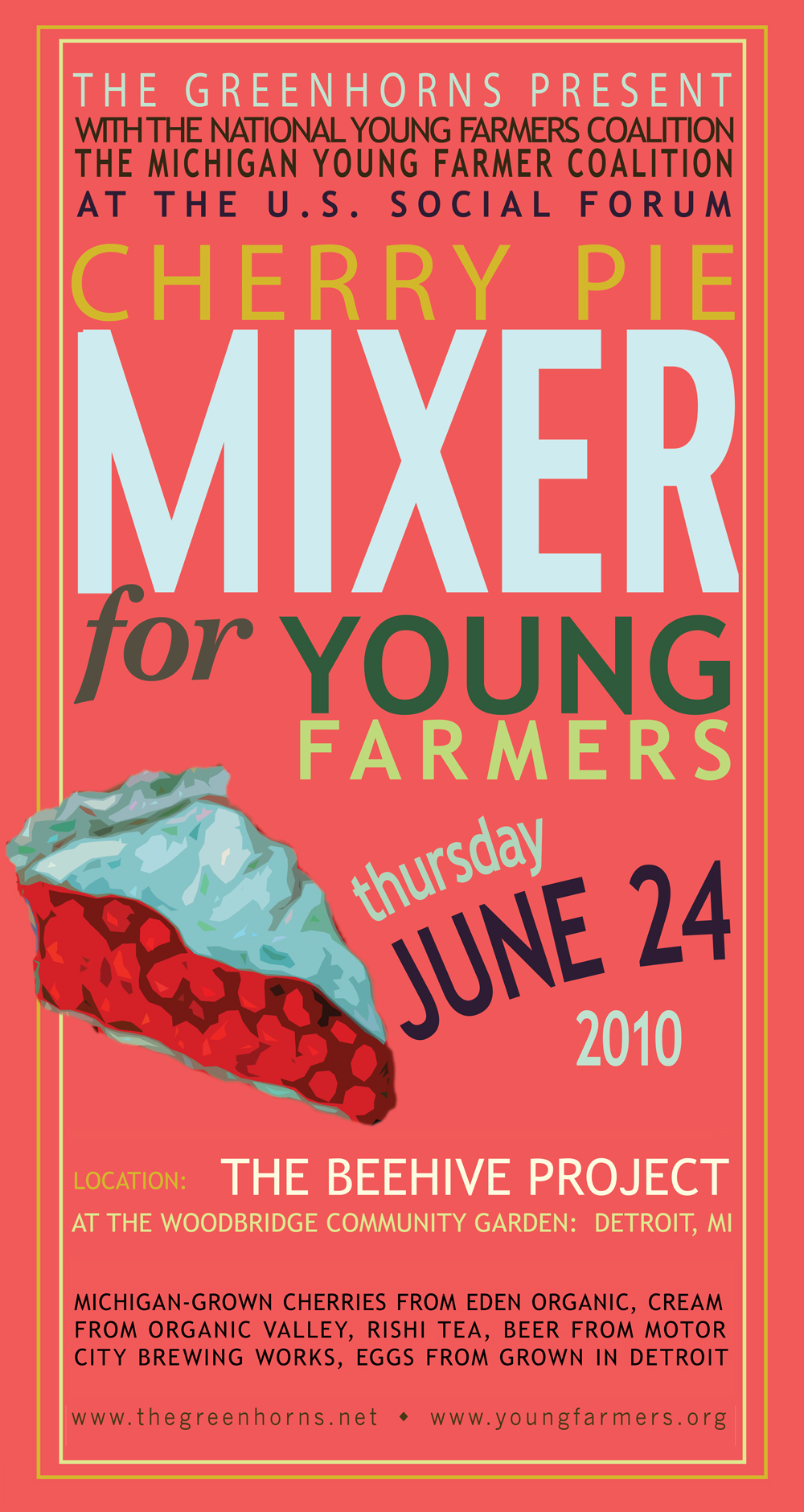
Flyer for the Cherry Pie Mixer.

Not completely garden-ed out for the day, we headed to the Young Farmer Cherry Pie Mixer organized by the Greenhorns at the Woodbridge Community Garden. And boy, was there cherry pie! So we mixed and mingled, pie in hand, with other young farmers and farm supporters, from Michigan and Missouri and Maine and California. I talked with one man who was in the mead-making business and thus decided to start harvesting his own honey, setting up hives across the city of Detroit. Before long, we were gathered together via bullhorn and given an introduction by Severine von Tscharner Fleming, documentarian and Greenhorn. Then Reverend Billy from the Church of Stop Shopping shouted us some proclamations about the revival of small agriculture in the face of overwhelming empire. Shortly thereafter, a keg of Motor City Brewing Works finest Ghettoblaster ale was tapped inside the up-and-coming art project of the Beehive Project, a “large-scale installation by an interdisciplinary community of artists and thinkers in Detroit” – not to be confused with the Beehive Collective, also awesome.

Reverend Billy preaching in front of the Beehive.

Tired and to bed.

Day Twelve:

BikeIt: Pedal to the USSF – Testimonials and Exploration of the Bicycle as a Tool for Social and Environmental Justice.

Welcome to the last day of thinking – for a while. Being a promoter of pedal-powered transit (even while in a skirt, transporting garden tools), I decided to buckle down with some bike riders. Two main bike contingencies shared their stories about biking to the US Social Forum. One from Ithaca, NY – covering 500 miles in 8 days. The other from Madison, WI – covering 300 miles in 8 days. Coordinated through the Bike-It Project, organized to promote biking alternatives and push both physical and mental limits. Each of the groups were followed by support vehicles – including the Permaculture Bus from Montana. Each made stops in communities to volunteer and build community within the collective through skill shares. Ages of bikers ranged from 9 to mid-70s. Bike collectives represented: Spoke ‘N Heart Collective (Atlanta), the Garlic Derailleurs (Chicago), the Grassroots Caravan (Madison) and the Petrol-free Gypsy Carnival Tour.

Saddle bag for bike made from refashioned kitty litter boxes - workshops lead by Petrol-free Gypsies.

Beyond sharing stories, we collectively identified issues and inhibitors of bicycles as the main form of transportation – as well as populations typically marginalized from biking communities. And brainstormed ways of making biking accessible to all, while building community and sharing skills while delving into the deeper topics of race and privilege. This is the beauty of the bike. To pass through new places and ponder the people and their stories.

We Agrarians gathered together for the rest of the afternoon to process yet we had learned – and what to do with all that stuff once we got back to our places of origin. This was also our farewell. Might I add that a number of our Road Trippers will be returning home to plant gardens and wear more plaid.

Road Tripper group photo on our last evening together.

Day Thirteen:

Already some of our group had disbanded before breakfast. The rest of us headed to Detroit’s famed Eastern Market for some good eats before hitting the road (watch the video of our trek through the Market). The Eastern Market has been in existence since 1891 – and currently is a common source for groceries for a number of residents in Detroit. While there are a fair share of resellers (all those “farmers” who sell produce with stickers on them), there were a plethora of local bakers, urban farmers, and cheese makers. Even a few Amish farmers who start their trek to Detroit at 2am every Saturday. I also located my honey man and bought a jar of his Wild Detroit Honey.

Getting a wee bit road weary at the Eastern Market.

Then we started on our road home. Or at least to Louisville. And that’s where my story ends.

Ready to hit the road for home.

End Day Thirteen. End Part Six.

Friday, July 2, 2010

Agrarian Road Trip: Part Five.

Joe Louis welcomes the Agrarian Road Trippers to Detroit.

No Jobs, Bad Transit, Good Gardens:

the Agrarian Tour through Detroit

Finally arriving in our destination, we – Agrarian Road Trippers – jumped head first into Detroit’s urban agriculture scene to hob-knob with some agrarian minded folks in Detroit – the folks who will remain to keep on fightin’ the good fight, even after the Social Forum vacates the city.

Day Nine:

Upon arriving in Detroit, we ate lunch with folks engaged in the US Working Group on the Food Crisis, a collection of people assembled to reinvigorate local food systems, craft new policy, monitor faulty policies, and represent the voices of growers across the country. Then we settled into our living accommodations at Fort Street Presbyterian in downtown Detroit before heading out for a tour with Lindsay Turpin from the Greening of Detroit.

Lindsday from Greening of Detroit leading us on a garden tour.

Lindsay works for the Greening of Detroit’s Garden Resource Program, helping start and support neighborhood and community gardens across Detroit. Detroit is sectioned into eight clusters, with each cluster containing one garden leader who communicates the resource and technical needs of each of the gardens inside that particular cluster. Right now, the Garden Resource Program oversees over 1200 gardens in Detroit.

Lovely lettuce.

Detroit’s had her fair share of bad news: high crime, high poverty, no jobs, bad transportation. However, a growing movement in the city is drawing the attention of outsiders. Urban agriculture in the city of Detroit is thriving. No the flip side, access to fresh food is a great concern – as there are no retail food chains inside the Detroit city limits. Large chains refuse to move into the city, stating that the demographics of consumers in city limits are not economically viable. Not to mention Detroit’s population is on the decline.

Such an environment has left Detroit residents no choice but to leave – or take up a shovel. With the help of the Greening of Detroit, folks are now gardening in full force, as well as learning how to keep bees and can and preserve their harvest. Greening has also started a youth employment program, called the Green Corps, to train youth in urban agriculture and urban forestry as well as teaching valuable job skills. Since 1998, over 500 youth have been employed through the Green Corps program.

Grown in Detroit - the documentary about Catherine Ferguson Academy.

One of the sites that we visited on our tour with Lindsay was Catherine Ferguson Academy – a high school for pregnant teens and teenage gals with children. The school has horses, chickens, bees, a mature fruit tree orchard, and over two acres in vegetable production. In addition to managing the livestock and tending the vegetables, the girls oversee a nursery and hoop house production to distribute plants to gardens throughout the city. Right now there are approximately 300 girls attending Catherine Ferguson – and all are allowed to bring their children to school for daycare services. Recently a documentary called Grown in Detroit was released, telling the story of Catherine Ferguson Academy.

I should also mention that it is against city code to keep livestock in the city of Detroit.

However, policies do not keep the Greening of Detroit from help more and more people grow and tend their own food sources. Partnerships are the background of the organization. The city helps with access to land – providing one year permits – while other land trust organizations with help community members buy the land over time. Greening is also fortunate to partner with Michigan State University’s Agriculture Department, so that a number of students complete their Ag Practicum in Detroit. Strong, diverse partnerships help Greening obtain funding from a number of sources: Kellogg and Kresge Foundations, MI AmeriCorps and AmeriCorps*VISTA, and Workforce Development.

As far as the problem with keeping livestock, Lindsay says that you need to make sure you have good relations with your neighbors. Give them some vegetables. Agrarians in Detroit aren’t just farmers – they are organizers. Recently Greening has received some requests to help with marijuana – but that’s an area Greening chooses not to go.

Recycled tire art at D-Town Farms.

Our next stop was D-Town Farms, a garden operated by the Detroit Black Community Food Security Network. D-town is a 2-acre plot, growing vegetables as well as operating a city tree nursery, bees, berries and mushrooms. In addition to in-ground growing, D-town has a number of tire container planters. Farmers at D-Town sell at the Eastern Market on Saturdays, as well as help facilitate a market cooperative called Grown in Detroit (not to be confused with the documentary), helping small growers into market growing.

Broadmoor Community Gardens.

Brightmoor Community Gardens was our final garden stop for the day. Brightmoor is the exemplifies urban plight in Detroit: a crazy cycle of high rent without security deposit keeps renters on their seats until they lose their jobs and evicted. As soon as the house is vacated, the house is stripped – of plumbing and wiring – left an abandoned shell, useless as a habitation. The costs to fix up the house now outweigh its overall value. So the house sits vacant. Unless a nearby gang is hosting an initiation – which frequently results in the burning down of vacant houses. In the midst of the craziness, there grows garden – or two or three or four.

Riet's backyard garden/farm and greenhouse.

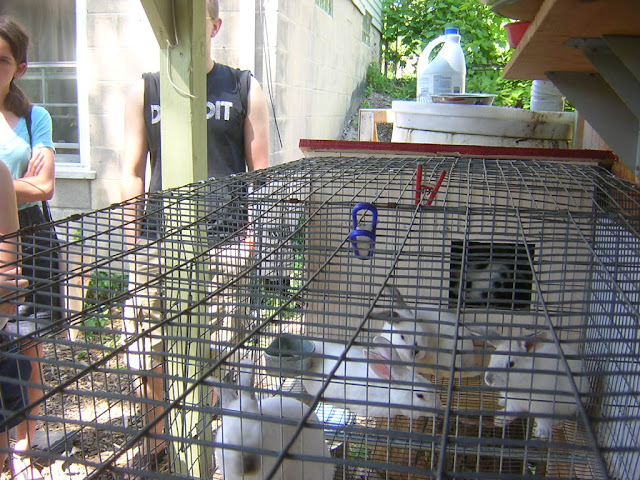
Brightmoor Community Gardens are headed by Riet Schumack, cluster leader for the area. She supervises the 22 kids who maintain the gardens, mow the grounds, paint garden murals, and plant fruit trees in the Brightmoor neighborhood of Detroit. The kids are under the understanding that working in the gardens is not a job – it is a profit-sharing venture, the more work each kid puts into the garden, the more money s/he will take home from market. Riet works with kids ages 9-18, increasing her ranks from 12 kids in 2007 up to the 22 she has now. Last year they produced 1,300 pounds of food from their collective gardens – which is distributed to the neighborhood families, as well as sold at Eastern Market and to a variety of area restaurants. In addition to helping neighborhood youth, Riet oversees her own backyard farm-stead, tending a garden and greenhouse and keeping bees for honey, chickens for eggs, and rabbits for meat.

Riet's rabbits.

With a crash course on urban agriculture in Detroit under our belts, we head back downtown for the March to the US Social Forum and Opening Ceremony. Then an evening of preparing for our workshop the next morning.

End Day Nine. End Part Five.