Showing posts with label poverty. Show all posts

Thursday, July 29, 2010

Texas at the Table: Part Two.

the Birds, the Bees and the Apple Trees

at the Table in Lubbock, TX

Having an initial crash course in Waco about the complexity of our food system, we – the lovely ladies of the Texas at the Table: Project Go Road Trip – made a bee-line for Lubbock to learn about (food) banks, bees, and Baptists. Lubbock was the second stop on the Texas at the Table Road Trip to explore how people across Texas creatively address hunger in their communities – or more simply, exploring where food comes from, who gets it, and who doesn’t.

Outside Steve's Market and Deli. Brownwood, TX.

Day Three: Beginning our trek from the World Hunger Relief Farm in Waco, TX, we head to our second destination on the Texas at the Table Road Trip – Lubbock – and the “road” part of our trip commences. Happily loaded into our Ford Fusions, we start our journey for lunch in Brownwood, TX – home of Howard Payne University, college of one of our fine young ladies, as well as Steve’s Market and Deli. Steve’s is an unusual little nook for small town Texas – more akin to Austin eateries – and we happily welcome Dr. Bronners soap and vegetarian fare wherever we go. Or at least I do – the gals were probably just weirded out. But here at Steve’s we also meet a wonderful woman who works with Keep Brownwood Beautiful and oversees the Brownwood Community Garden. The garden is funded through economic stimulus money, complete with in-ground irrigation and rainwater catchment, and sits on the back property of Salvation Army.

Inside Steve's.

After lunch, we take to the road once again to arrive in Lubbock and meet our hostesses – Vangela and Tish and the wee little Connor. Over dinner, we co-mingle with folks from the South Plains Food Bank – where Vangela works. Then one final stop before heading home to Vanela’s – the library. The library is a notorious sleeping spot for many of the homeless in Lubbock. We drop off extra food from our dinner to the men sleeping under the overhang. I met a recovering hippie named Woodstock who sleeps at the library when he can’t find a ride home. We part ways as it begins to rain.

the beautiful front facade of the South Plains Food Bank.

Day Four: Another bright and early morning. Heading to Kitchen of Hope, a project of the South Plains Food Bank, where many of the meals are prepared for the various Kid’s Cafe sites – an after-school snack and meal program for low-income kids sponsored through Feeding America, the national network of food banks. Kid’s Cafe in Lubbock also sponsors the summer lunch program. Next, we visit the Church of Jesus Christ of Latter Day Saints in Lubbock, as they are hosting a youth summer camp for LDS teenagers in the area. We watch a film about the commitment to service in the church in response to the Gospel. Then Vangela shares her story, being a single-parent of a special needs child, losing her job, and needing the support of the Food Bank in tough times. Now she is able to give back. And so can these kids. They are spending their morning going door-to-door to collect canned goods for the Food Bank. Originally the kids were going to volunteer at the Food Bank, but due to a shortage, there isn’t enough food for volunteers to organize.

Looking at flood damage at the GRUB farm.

From the LDS church we head to the GRUB Farm, another project of the South Plains Food Bank, where we did some flood-damage control, after the recent hurricane rains. GRUB stands for Growing Recruits in Urban Business – a youth entrepreneurial agriculture program to train young folks how to grow fresh fruit and vegetables – 50% of which is distributed through the Food Bank, while the remainder is sold through a CSA. Local students who participate in the GRUB program also sell produce at local farmers markets. After the GRUB Farm had been in operation for a few years, a survey was conducted to assess whether the program was benefiting the lives of the youth who participated. Much to the amazement of those in charge, the youth knew how to grow vegetables but had no idea how to eat them. Thus started another important component of the GRUB program – cooking lessons as well as other value-added programs. The kids also sell GRUB Scrub, loofah soap that they have grown and made themselves. The GRUB Farm receives agricultural and technical support from Texas Tech – professors and students conduct experiments with season extension and vegetable varieties, which are then integrated into the GRUB program. Because so many youth work at the Farm, the site also participates in the summer meal program.

GRUB mobile market trailer - built by Texas Tech students.

For lunch, we head to the main location of the South Plains Food Bank. Kitchen staff have prepared us a gourmet meal from food bank food – and we dine in elegance along many higher ups of the food bank – including the executive director David Weaver, who shares many stories of the people he encounters visiting the food bank. Meagan, who oversees volunteers, leads us on a tour of the Food Bank warehouse – showing us typical food boxes of dry goods, refrigerated goods, and fresh produce. The South Plains Food Bank is unique in that rather than distributing food to various social service agencies (which in turn distribute the food through direct social service) throughout the city, food is directly dispersed through the main food bank location. This poses problems in transportation – because the warehouse is located outside of town and bus access is severely limited.

Apple Country Orchards, Idalou, TX.

With hearts heavy and bellies full, we head out towards Idalou, TX, to fulfill a life-long dream of Mallory’s – picking apples. We drop in announced to visit Cal at Apple Country Orchards, for an afternoon of apple-pickin’. City girls picking apples. Cal is patient and polite with us. Even entertaining us afterwards with some German Apple Cake as well as some of his cotton honey – and stories of bees and children. He tells us of his struggles to educate children about where their food comes from – a project made tougher by the presence of parents, who are quick to nay-say the yumminess of an Early Blaze apple or Armenian cucumber (a new found favorite amongst Road Trippers). In order to subvert the minds of little ones, he separates the little ones from their parents and has them eat. And the taste tells the rest of the story. That and Cal’s demonstrations of bee pollination, buzzing merrily amongst fruiting flowers. He charmed us too with his tales of bee life and raw honey.

Mallory, living the dream.

Thanks to the overabundant hospitality of Vangela and Tish, we went back to their home for a dinner (at this point I should say that the majority of our meals were prepared and provided by the Food Bank kitchen staff). Then an evening on the town at a local coffee shop called Sugar Brown’s Coffee, where we made a new friend who happened to be a magician.

the Downtown Art Market - or DAM for short.

Day Five: A Saturday. Finally a weekend and some time for rest. Although, my – Bethel’s idea of rest seems to be vastly different than the rest of the gal’s. I prefer to sleep in until 8am. On a Saturday. Especially when there’s a farmers market to be gotten to. And so I rallied the ladies – much to their chagrin – and all headed to the Downtown Art Market. Random fact: Buddy Holly was from Lubbock. At the Downtown Art Market, we found vendors of all varieties, including: a lady named Emma who makes salsa (which we bought), many a jewelry maker, GRUB farm kids, Apple Country Orchard folks

(also bought some Armenian cucumbers and red raspberry preserves), and two lovely ladies making soap with wonderfully creative “flavors” like Ziegenbock.

Spanky's - 'nuf said.

Lunch was paradoxically taken at a local favorite, Spanky’s. Our meal consisted of fried mushrooms, fried okra, fried cheese, and French fries. Hey, some times you gotta keep it real. We ended our evening in style swimming in a gated community and dessert in a hot tub. At the home of the Food Bank’s executive director. There was also a deeply stimulating conversation concerning which ice cream flavors best embody the spirit of each Road Tripper. Example: Mallory – Blue Bell’s Birth Day Cake; Bethel – a mash-up of Homestead Heritage‘s Sorghum Pecan with homemade goat’s milk ice cream. Much sleep needed.

at Second Baptist, with Pastor Ryon and Pastor Ben.

Day Six: Egg breakfast, complements of the Food Bank. Love infused into the eggs, complements of Tish. Worship at Second Baptist – church of Vangela and David. Us gals split up into two groups to speak at the college and Boomers Sunday school classes. Then we worship with Harry Potter – actual name Ryon Price, a graduate of Duke Divinity School and new pastor at 2nd B. Sermon entitled “Like A Good Neighbor” – not referring to State Farm Insurance, but rather reflections on the story of the Good Samaritan. Pondering the question who is my neighbor, but on a deeper level, for the question asked to Jesus implies that certainly they are people who are not considered to be my neighbor. There are people that we need not be concerned for. There are people who are not considered to be my brother or my sister. But Jesus answers the tax collectors question with a parable-infused question – in typical Jesus-fashion. A good teaching as we take to the road again – and attempt to understand on this trip, deemed a mission trip, that ministry is not just confined to the few moments we haughtily choose to deem as missional.

End Day Five 1/2. End Part Two.

Friday, July 2, 2010

Agrarian Road Trip: Part Five.

Joe Louis welcomes the Agrarian Road Trippers to Detroit.

No Jobs, Bad Transit, Good Gardens:

the Agrarian Tour through Detroit

Finally arriving in our destination, we – Agrarian Road Trippers – jumped head first into Detroit’s urban agriculture scene to hob-knob with some agrarian minded folks in Detroit – the folks who will remain to keep on fightin’ the good fight, even after the Social Forum vacates the city.

Day Nine:

Upon arriving in Detroit, we ate lunch with folks engaged in the US Working Group on the Food Crisis, a collection of people assembled to reinvigorate local food systems, craft new policy, monitor faulty policies, and represent the voices of growers across the country. Then we settled into our living accommodations at Fort Street Presbyterian in downtown Detroit before heading out for a tour with Lindsay Turpin from the Greening of Detroit.

Lindsday from Greening of Detroit leading us on a garden tour.

Lindsay works for the Greening of Detroit’s Garden Resource Program, helping start and support neighborhood and community gardens across Detroit. Detroit is sectioned into eight clusters, with each cluster containing one garden leader who communicates the resource and technical needs of each of the gardens inside that particular cluster. Right now, the Garden Resource Program oversees over 1200 gardens in Detroit.

Lovely lettuce.

Detroit’s had her fair share of bad news: high crime, high poverty, no jobs, bad transportation. However, a growing movement in the city is drawing the attention of outsiders. Urban agriculture in the city of Detroit is thriving. No the flip side, access to fresh food is a great concern – as there are no retail food chains inside the Detroit city limits. Large chains refuse to move into the city, stating that the demographics of consumers in city limits are not economically viable. Not to mention Detroit’s population is on the decline.

Such an environment has left Detroit residents no choice but to leave – or take up a shovel. With the help of the Greening of Detroit, folks are now gardening in full force, as well as learning how to keep bees and can and preserve their harvest. Greening has also started a youth employment program, called the Green Corps, to train youth in urban agriculture and urban forestry as well as teaching valuable job skills. Since 1998, over 500 youth have been employed through the Green Corps program.

Grown in Detroit - the documentary about Catherine Ferguson Academy.

One of the sites that we visited on our tour with Lindsay was Catherine Ferguson Academy – a high school for pregnant teens and teenage gals with children. The school has horses, chickens, bees, a mature fruit tree orchard, and over two acres in vegetable production. In addition to managing the livestock and tending the vegetables, the girls oversee a nursery and hoop house production to distribute plants to gardens throughout the city. Right now there are approximately 300 girls attending Catherine Ferguson – and all are allowed to bring their children to school for daycare services. Recently a documentary called Grown in Detroit was released, telling the story of Catherine Ferguson Academy.

I should also mention that it is against city code to keep livestock in the city of Detroit.

However, policies do not keep the Greening of Detroit from help more and more people grow and tend their own food sources. Partnerships are the background of the organization. The city helps with access to land – providing one year permits – while other land trust organizations with help community members buy the land over time. Greening is also fortunate to partner with Michigan State University’s Agriculture Department, so that a number of students complete their Ag Practicum in Detroit. Strong, diverse partnerships help Greening obtain funding from a number of sources: Kellogg and Kresge Foundations, MI AmeriCorps and AmeriCorps*VISTA, and Workforce Development.

As far as the problem with keeping livestock, Lindsay says that you need to make sure you have good relations with your neighbors. Give them some vegetables. Agrarians in Detroit aren’t just farmers – they are organizers. Recently Greening has received some requests to help with marijuana – but that’s an area Greening chooses not to go.

Recycled tire art at D-Town Farms.

Our next stop was D-Town Farms, a garden operated by the Detroit Black Community Food Security Network. D-town is a 2-acre plot, growing vegetables as well as operating a city tree nursery, bees, berries and mushrooms. In addition to in-ground growing, D-town has a number of tire container planters. Farmers at D-Town sell at the Eastern Market on Saturdays, as well as help facilitate a market cooperative called Grown in Detroit (not to be confused with the documentary), helping small growers into market growing.

Broadmoor Community Gardens.

Brightmoor Community Gardens was our final garden stop for the day. Brightmoor is the exemplifies urban plight in Detroit: a crazy cycle of high rent without security deposit keeps renters on their seats until they lose their jobs and evicted. As soon as the house is vacated, the house is stripped – of plumbing and wiring – left an abandoned shell, useless as a habitation. The costs to fix up the house now outweigh its overall value. So the house sits vacant. Unless a nearby gang is hosting an initiation – which frequently results in the burning down of vacant houses. In the midst of the craziness, there grows garden – or two or three or four.

Riet's backyard garden/farm and greenhouse.

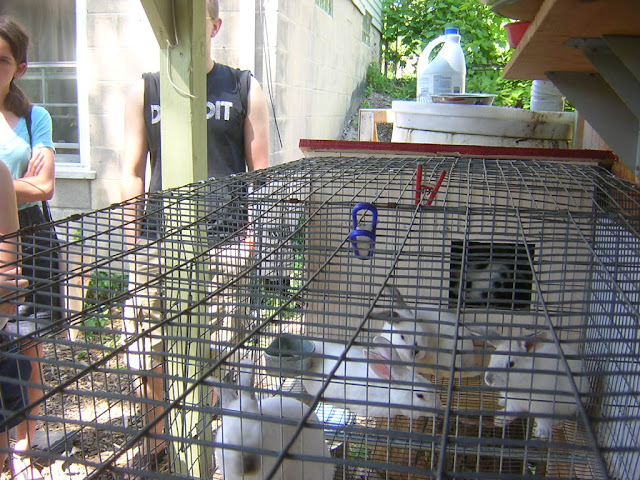
Brightmoor Community Gardens are headed by Riet Schumack, cluster leader for the area. She supervises the 22 kids who maintain the gardens, mow the grounds, paint garden murals, and plant fruit trees in the Brightmoor neighborhood of Detroit. The kids are under the understanding that working in the gardens is not a job – it is a profit-sharing venture, the more work each kid puts into the garden, the more money s/he will take home from market. Riet works with kids ages 9-18, increasing her ranks from 12 kids in 2007 up to the 22 she has now. Last year they produced 1,300 pounds of food from their collective gardens – which is distributed to the neighborhood families, as well as sold at Eastern Market and to a variety of area restaurants. In addition to helping neighborhood youth, Riet oversees her own backyard farm-stead, tending a garden and greenhouse and keeping bees for honey, chickens for eggs, and rabbits for meat.

Riet's rabbits.

With a crash course on urban agriculture in Detroit under our belts, we head back downtown for the March to the US Social Forum and Opening Ceremony. Then an evening of preparing for our workshop the next morning.

End Day Nine. End Part Five.

Agrarian Road Trip: Part Three.

Coal Country, West Virginia.

Take Me Home, (Coal) Country Roads:

the Agrarian Tour through West Virginia

One of the unofficial theme songs for us – Agrarian Road Trippers – has been John Denver’s “Country Roads” – mainly because of the line “West Virginia. Mountain Mama. Take me home. Country Roads.” And West Virginia – or at least the southwest region – has her fair share of country roads. It is in the midst of these country roads that we have visited and shared stories – as well as a few bluegrass tunes, picked out on banjo and guitar – with fellow agrarian minded folks in Coal Country, West Virginia.

Day Six and Day Seven:

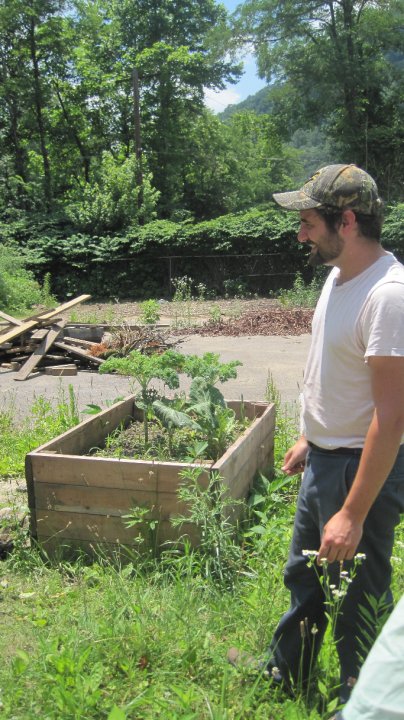
Mullens Community Garden at RAIL.

Our main contact in Mullens, West Virginia, is the organization Rural Appalachian Improvement League (RAIL), where we hook up with fellow young agrarians Jack and Becky. Jack has been working with RAIL since 2008. Originally from West Virginia, Jack was hired to start a farmers market in Mullens – only problem being there were no farmers. This is coal country. No one farms here. In order to tell his story of the work he has done with RAIL, Jack first had to share the story of coal in Mullens and her surrounding coal camps.

the Locals.

First off, there aren’t towns. There are coal camps – little “villages” created by the coal companies to house miners. These houses were built precariously upon steep mountain hillsides, with little space betwixt neighboring houses – seldom a yard or septic tank. Today, 65% of all sewage in Wyoming county is directly pumped into the river running through the camps. This is not to mention the additional run-off dumped by the coal industry. This is the water – should agriculture gain momentum – that will be used to irrigate gardens and livestock. In 2001, Mullens suffered a drastic flood, water climbing to ceilings on the first floor story of buildings and homes throughout the town. Although a flood to this magnitude is not common, seasonal flooding happens on a regular basis. For the beginning agrarian, having your garden washed away at least once per season is quite the discouraging start.

Farmer Jack at the Mullens Community Gardens.

However, Jack sees gardening as one step towards self-sufficiency for the people living in communities historically tied to the coal industry. In former times, the coal companies outlawed gardening in coal camps – thus making coal miners and their families dependent on purchasing food from the mercantile stores operated by the coal companies. Although growing gardens is no longer illegal, the coal companies still own 85% of the land in Wyoming county where Mullens is seated. Another 5% of the land is owned by state and federal government – leaving a mere 10% of land available to the people for housing, parks, gardens and businesses.

Visting a neighboring gardener and his horse Hank.

Coal is in the blood of the people,” one local woman from the organization, Friends of Milam Creek, told us. Out of the 20,000 people in Wyoming County, only 800 are employed in the coal industry. Employment in coal has drastically decrease with the rise in mechanization of the industry. Although most people living in coal country know at least one person who has died of black lung, jobs in the coal industry are the most sought-after. A coal miner with a high school education can make more money in a year than a college professor with a PhD. The balance of health-versus-wealth is a thin line to walk in the coal industry. Jobs for the remaining individuals span mechanical labor, food service and retail. Many area youth drift away from their communities when – and if – the opportunity arises.

Note: bumper sticker.

With all these thoughts muddling up my mind, we head out to the RAIL Community Garden – to mull over thoughts and pull some weeds. In addition to locating spaces for community residents to “farm” – there is a stigma attached to the lesser work of gardening – RAIL provides workshops on growing food, canning and preserving, and hosts a farmers market on RAIL’s property. Fresh food is grown for sale at market, for donation to food pantries, and for family consumption of those who grow it. We visited a few more gardens before harvesting some vegetables for our own dinner. At our last stop I noticed two bumper stickers both at the same house: “Nader/Gonzalez” and “I ‘heart’ Coal” – an interesting combination rarely replicated in any other community.

Note: political sign.

It doesn’t take an agrarian-minded person to connect the story of coal country economics in Appalachia to mechanized, mono-cropped agriculture in the Midwest. (The average age of a farmer in America today is 57.) Disillusioned youth are encouraged to seek educational opportunities elsewhere due to the lack of vocational attachment to the industry of the area. To leave is to succeed. Rarely applauded or honored are those who choose to stay. To mine. To farm. Outside do-gooders with liberal arts educations grounded in service to community are heralded by their own communities as heroes. But those who choose to stay are seen as having missed their golden opportunity.

West Virginia, Mountain Mama. Country roads, take me home.

End Day Seven. End Part Three.

Tuesday, May 11, 2010

Don't explode your brain

This post was originally published at Yellow Inkling.

I had a great discussion with our current Service Learning group about what can practically be done – by you and I - about poverty in this world. But wait – what’s a Service Learning group?

P4300855 At World Hunger Relief, we host several Service Learning groups a year. Part of the mission of the Farm is to “educate those with an economic abundance on methods of conserving and sharing resources.” Our Service Learning program, along with our fun-filled (and rabbit poop, worm, goat, chicken, garden-filled) Farm tours, and sending farmers off the Farm to speak, are ways we do this in our community. And...surprise! One of my main jobs here on the Farm is to manage all three of these education programs.

Our Service Learning groups come from schools, churches, families, and universities. They stay for varying lengths, from 8 hours up to two weeks. During Spring Break time (March-April) we are super busy with several Alternative Spring Break groups from colleges around the country.

Right now we have a National Summer Service Team from University of Michigan on the Farm. They’re one of our longer- staying groups just a day shy of two weeks. They’ve been an ideal group and I’ve really enjoyed getting to know them.

Last night I hosted one of my favorite Service Learning activities for them – Hunger Meal. The activity includes a meal, a presentation, and a discussion at the end. At the beginning, each participant chooses a life situation card. The card includes a name, country of residence, income bracket, and a short description of daily life – struggles, work, family, etc. Each participant is then fed according to the card they randomly picked.

I try to schedule this activity after a hard day’s work and the groups are asked not to snack between lunch and the activity which typically takes place during the evening. The “high-income” people are seated at the table with a ridiculous amount of food, usually including a balanced meal with meat, several beverage selections, and dessert. “Middle-income” participants are seated in a chair and are given beans and rice in a bowl with a spoon and a glass of water. “Low-income” participants are seated on the ground and given a large pot of rice to share amongst themselves, along with glasses of “dirty water” (water colored light brown with a splash of coffee or tea). It usually breaks down to about 15% of the group being high-income, 25% middle-income, and 60% low-income.

While the participants eat, they share their cards and I present current statistics and issues regarding world hunger and poverty.

In all honesty, although this is my favorite Service Learning activity to lead, it’s a difficult one. It’s difficult to talk about hunger and poverty in regards to statistics and generalities. In fact, in the past, I’ve often avoided talking about these problems because I didn’t know of a good way without mentioning the often sterile and meaningless statistics. But after first learning how to lead this activity I realized something – some people have never heard these statistics; they might know that there are hungry people in the world, but they don’t realize that it’s a sixth of earth’s population. I’ve learned that it’s okay to start with: currently, there are 1.6 billion people living on less than $2 a day – 900 million people in this world go hungry every day.

I say this to people who, at this point in the day, are very hungry themselves, given a handful of rice after a many hours of hard work. Then, I move closer to home – Texas is the second hungriest state in the Union – 15% of people living in Texas go hungry every day. After presenting the dry facts (that may be less dry with rumbling stomachs), I share what the Farm is doing and what they can do themselves. Last night we had a great discussion about this.

The issue was this: what can we practically do about poverty in the world? The problem is a big one and if we were to think about all the complexities at the same time and worry about and try to solve all of them, our heads would explode our pink brains everywhere. Instead, we discussed a few important steps. If you are wondering about what you can do, read on. This is what we came up with.

  1. Education – educate yourself about what’s going on. Familiarize yourself with some statistics. I told the group last night that they were in fact doing something about poverty and hunger by taking that first step: coming to the farm and learning about what’s going on in Waco, Texas, our country, and the world. You can start with our links. Quick intros like 12 Myths About World Hunger are also a good start.
  2. P3150781People – surround yourself with like-minded people, people who care about these issues and want to learn more, too. They don’t have to have the same ideas as you – in fact, the purpose of finding like-minded people is to learn from them and share perspectives, while also being encouraged. This was one of the reasons why I wanted to come to the Farm. These people are everywhere – your school, your church, maybe your family, your friends (exhibit A: the lovely specimens pictured above.) There may be groups near you that are already meeting and doing something (think Texas Hunger Initiative, McLennan County Hunger Coalition, Heart of Texas Urban Gardening Coalition, etc).
  3. Resources and Your One Thing – As people that live in America, we have to start looking at where we are putting our resources. This is often the hardest step. Even those who don’t consider themselves “rich” have enormous amounts of resources (money, time, influences). As we talked about this last step, we decided that the best way to handle this is to start small. Pick one part of your life to examine. A few years ago, when James and I first started looking specifically at the issue of hunger and how it relates to the food system, we decided to pick one thing to change.
P9100078 I started with my eggs. We eat a lot of eggs and I knew that most of the eggs sold in grocery stores were produced by chickens that were abused, pumped full of grain (which could be used elsewhere) and antibiotics, and cared for by people who are often abused themselves by employers. And so we concentrated on eggs: just finding a supplier for eggs that I knew, either through friends or the farmer’s market, or even getting a few of my own chickens. After we did that, we went on to milk, then meat. But we took it one thing at a time. And yes, sometimes that one thing took six months to solve, find, or incorporate into our lives. But since we did gradually, it didn’t make our brains go ka-boom-splat.

Maybe you drink an insane amount of coffee – maybe that could be your “one thing.” Take time and find out where your coffee comes from. With coffee being one of the biggest reasons why modern slavery exists, you could take some time and find a Fair Trade supplier or talk to your local coffee shop owner about serving Fair Trade coffee.

Fair trade net-logo Fair_Trade_Federation_Logo Transfair-usa-logo

So, go! I release you from this ridiculously long blog post. Go learn and educate – go find those like-minded people (come to the Farm!) – and find and start with your one thing.

Oh, and if you get stuck, drop us a line at the Farm.

(Maybe your thing is Vodka? Solved. Ha.)

Monday, July 13, 2009

Food in the Bible: Sabbath

When I wrote a post on Joseph's experiment in redistribution, I was stunned by what I found. It is still profoundly disappointing to see such injustice, particularly in our own scripture. As I pondered that, however, I thought that perhaps the Year of Jubilee in Leviticus 25 is the antidote. In Joseph's story he tries to bring about a just distribution of goods and fails miserably. In Leviticus 25 we are given a model that seems to undo this kind of injustice, but scholars tell us it was probably never tried. This idea that Jubilee is the antidote to our failing human efforts at justice brings me to a foundational concept in Scripture that serves as a basis for much of my thinking on food, poverty and justice... Sabbath.

J.D. Crossan in God and Empire says, "It is not humanity on the sixth day but the Sabbath on the seventh day that is the climax of creation... our 'dominion' over the world is not ownership but stewardship under the God of the Sabbath" (53). The reason that scripture gives for observing the Sabbath is not worship, which most Christians and maybe Jews seem to think. The reason given is so that the slaves and foreigners could have rest as well (Ex 23:12; Deut 5:14). Again Crossan says,
The Sabbath Day was not rest for worship, but rest as worship... In summary, the Sabbath was about the justice of equality as the crown of creation itself (54).
The Sabbath Day is extended to the Sabbath Year (Ex 21:2 and Deut 15) and finally the Sabbath Jubilee (Lev 25). Every seventh year both male and female slaves were to be set free and debts were remitted, or forgiven. Provisions are given for both male and females to ensure that they are cared for within the social context of the time. Both male and female slaves are to be restored to a just and equal standing in the community when they are set free. Deuteronomy warns that masters should not consider this a hardship. Lenders are also warned that they should not withhold loans from their needy neighbors when the seventh year is close. "Your neighbor might cry to the Lord against you, and you would incur guilt" (Deut 15:9)

The Jubilee goes even further by commanding that every seventh Sabbath Year "you shall return, every one of you, to your property and every one of you to your family" (Lev 25:10). God had divided the land up between the tribes, but knew that inevitably inequality and injustice would creep in. The Jubilee is the final rule that prevents inequality from remaining within the people of God. Lest we think this applies only to Israel or the church, remember that the purpose of God's covenant with Abraham constituting the people of God was that "all the families of the earth shall be blessed" (Gen 12:3). Israel was meant to be a model to the rest of the nations of what it meant to live in relation to God and each other.

The Sabbath was not just about people either.

"For six years you shall sow your land and gather in its yield; but the seventh year you shall let it rest and lie fallow, so that the poor of your people may eat; and what they leave the wild animals may eat. You shall do the same with your vineyard and your olive orchard" (Ex 23:10-11).

The whole of creation rests on a foundation of balance between work and rest. This passage also clearly indicates the relationship between the work and rest of the land and the people as well as the implications for equality and justice. Thus the right ordering of relationships, between people and between people and the earth involves a balance of work and rest which ultimately results in just distribution of resources.

Crossan sums it up by saying that through the progression of Sabbath laws "we can see clearly the demand of God for a just distribution of land-as-life based on the creation theology in Genesis 1:1-2:4a" (71).

Originally posted at What Would Jesus Eat? this is part of an ongoing series reading through the Bible with food as a lens.