Showing posts with label alumni. Show all posts

Friday, August 6, 2010

Farmer Brad in Ft. Worth,

World Hunger Relief, Inc.'s former Farm Manager:

Special Speaker: Brad Stufflebeam
"Organic Farming in Texas"
Hosted by: Organic Gardening Club of Ft. Worth

DATE: August 24th, 2010
TIME: 7pm
LOCATION: Ft. Worth Botanic Garden Auditorium, CLICK HERE FOR DIRECTIONS>>
MORE: The Organic Garden Club of Fort Worth is delighted to announce that Brad Stufflebeam of Home Sweet Farm will be speaking to our club on August 24th. Brad has excellent experience and credentials in organics. He and his wife Jenny operate a successful CSA farm in Brenham Texas west of Houston. As former TOFGA President, he understands the needs and benefits of organic practices. His knowledge of food production and marketing is vast and this is an incredible opportunity to learn from him. The club meets at the Fort Worth Botanic Garden, in the auditorium with the meeting starting promptly at 7 p.m. We hope you will join us and learn from this valued speaker. Visit the OGCFW website for more info, CLICK HERE >>

Monday, July 5, 2010

Agrarian RoadTrip: Part Six.

Sharing Our Stories over Cherry Pie, Blueberries and Beer:

the Agrarian Tour at the 2010 US Social Forum

In this our final leg of the journey, we – Agrarian Road Trippers – shared many a story with many an agrarian minded folk in Detroit – locals as well as way-faring strangers flocking to the US Social Forum – to prove “Another World is Possible, Another US is Necessary, and Another Detroit is Happening.”

Day Ten:

Headed towards our workshop.

“Faith Communities in the Local Food Movement: Sustainable and Just!” – this is the culmination of our wayward travelings on the road. A workshop at the US Social Forum, by us. One of thousands. And close to a hundred other workshops happening at the same time as ours, including: “The Coalition of Imokalee Workers: Fighting for Fair Food” and “Re-Purposing Auto Factories to Manufacture Renewable Energy Infrastructure” and “How to Start a Raging Grannies Group.” With over 17,000 people expected to be in attendance, how were we to compete against Raging Grannies? We set our expectations low – maybe four people will show. If we’re lucky, the crowd will outnumber us presenters (15). Thankfully, the good Lord provided, and we hosted a crowd near 60.

Recruiting participants for our workshop.

Andrew (organizer for the Presbyterian Hunger Program – and our fearless leader) introduced our tour with the aid of Blain, morphing into a tale of our trip across eight states led by Kate. Three gals (Amy, Laura, and yours truly) shared a testimony of the work we are doing at home, connecting the realms of faith and food justice. Then we split into small groups to learn about the good work of those so politely listening to our journeys. To emphasize the faith component of our time on the road, Talitha expounded upon our beloved passage from Exodus 16, first shared with us by Ellen Davis back in Louisville, before we calmed our minds for a sacred eating reflection. Jud passed around blueberries, asking us to think of all the people who came into contact with this blueberry before it finally reached us. The farmworker, truck driver, grocery store employee, cashier, Monsanto madman, etc. Then we closed our eyes, thinking about the life of just one of those people, while savoring all the flavors of that one blueberry. We opened our eyes to share our experiences and continue our fellowship, sharing how we want to be involved in our food systems back home – and help our faith communities with our food systems.

Not everyone was a Christian. Not everyone was connected to their food systems. But that was the beauty of our communion together. We just set aside a little time to share a sacred meal. Together.

By Any Greens Necessary: Food as a Tool of Colonization and Joining the Resistance

This is the first workshop I attended. Intense. Hosted by Jade Walker, farmer from Mill Creek Urban Farm, and Chris Bolden-Newsome, farm educator at King High, both in West Philadelphia. Led our discussion about the struggles and movements of indigenous people throughout history for food sovereignty. We split into groups to discuss: Black Panther free breakfast program (before the USDA), Native American fry bread as example of dominate culture becoming sacred, Cochabamba Water War over the privatization of water in Bolivia, Landless Farmworkers Movement in Brazil to reclaim the commons for the benefit of all, and so many more. My group discussed the Zapatistas as reaction to the NAFTA signing in 1994 – and its impact on Mexico. A man from Mexico was in my group – and shared from personal experience how the trade agreement affected his family, farming and flight to the US.

Farmers fighting back, the MST - Landless Workers Movement - in Brazil.

We discussed organizing tactics – and the basic fact that WE ARE ONLY LIMITED BY OUR IMAGINATIONS! That the struggle for food sovereignty is still happening. As Jade said, “Colonization is not over. Sometimes it looks like gentrification. Sometimes it looks like limited access to resources.” As we continued to delve deep into these struggles, we were faced with our own stories – the stories of our people, the stories of our connection to the land. Our stories are our resistance to a culture that wants us to accept French fries as food, television as community. Our stories must be shared.

Re-Localization and the Role of the Rustbelt.

Next, hanging out with the Michigan Young Farmers Coalition to hear about some of their young farmer stuff. Gardens. Farms. Animals. Hoop Houses. Hoorah! One particular project – the Haven Garden Project - was started by a Michigan State Ag student with a womens shelter in Pontiac, MI, using permaculture methods and the resources of MSU’s greenhouses and other resources. The shelter serves 15,000 women each year. Limited access to fresh food in the community. Growing food for the shelter on 1/5 acre – improving the soil with compost to build raised beds. Surplus goes to a food pantry. Starting a relationship with a local chef to teach the women what to do with the food they grow.

After another day of food and farming, I was burnout. So my new Agrarian friends and an old farm buddy met up for a taste of the local culture at Motor City Brewing Works, a local microbrewing specializing in handcrafted ales and o-so delicious pizza. (Darren’s favorite: Mary-Had-A-Little, topped with roasted lamb!) Then to rest for another full day.

Day Eleven:

Ending Mountaintop Removal

My first workshop was canceled – with two very large, armed men standing outside the entrance. So I made my way to another workshop, led by the Rainforest Action Network. Because of our visit to Mullens, WV, communities living in coal country have now caught my attention. So I thought I would attend and not start trouble with the large, armed men. Activists convened to hear the story of one woman who has lived life, not in coal country, but in a community where the coal industry has decided to mine: “We don’t live where they mine coal; they mine coal where we live.” Her husband worked for the coal industry for 35 years, before dying of Black Lung. Now she feels she has no choice but to speak against the industry that has made her home Ground Zero for coal excavation. She expounded on the millions of pounds of ammonium nitrate used everyday to blow the tops off mountains – the same ingredients Timothy McVeigh used for the Oklahoma City Bombing. “When it happened in Oklahoma City, it was a tragedy. When it happens in Appalachia, it’s called progress.”

Coal: the tension between activism and the economy.

Of course, the solution to mountaintop removal is not clean cut. Communities may be 100% against mountaintop removal while being 100% dependent on coal for energy. Another tension arises between activists wanting an end to the use of coal vs. communities that are dependent on coal for employment – an issue that became apparent at the workshop.

Regarding health and environmental quality, the people of Appalachia have nothing to lose, and everything to gain. But their story needs to reach beyond the hills and the hollers, into a larger forum. Only 8% of the coal that the US uses for energy is sourced from the Appalachian Mountain region, with the rest strip-mined from western plains regions. Yet, Appalachia has the most dense population of all regions where coal is sourced – thus making mountaintop removal the low-hanging fruit in our nation’s transition away from dependence on coal.

After almost ending mountaintop removal, I headed to a wonderful little street a few blocks away from Wayne State University, where many a local business thrived. Lunch was supplied by the wonderful hands of workers at Avalon International Breads and Goodwells. Then I bought the latest book by Gayla Trail, called Grow Great Grub: Organic Food from Small Spaces at an independent bookstore, part of the Spiral Collective.

Reclaimed house (one of many) at the Heidelberg Project.

After lunch, I joined a few friends to visit some Detroit hot-spots. First, the Heidelberg Project. An avant-garde art project, reclaiming a few blocks in Detroit – houses and all – into a massive waste-infused piece of art. Reflecting on themes such as stories told in taxis, created in God’s image, and many more subtle-ly overt political messages – a pink hummer buried in the ground, sprouting flowers.

Code Pink Hummer at Heidelberg Project.

Next stop, Earthworks Farm. Started by Capuchin monks to provide food for a neighborhood soup kitchen. Also providing seeds and plants for community gardens throughout the city, as coordinated by the Greening of Detroit. My favorite part: the Compost Monster, resembling the Loch Ness monster atop a huge heap o’ compost.

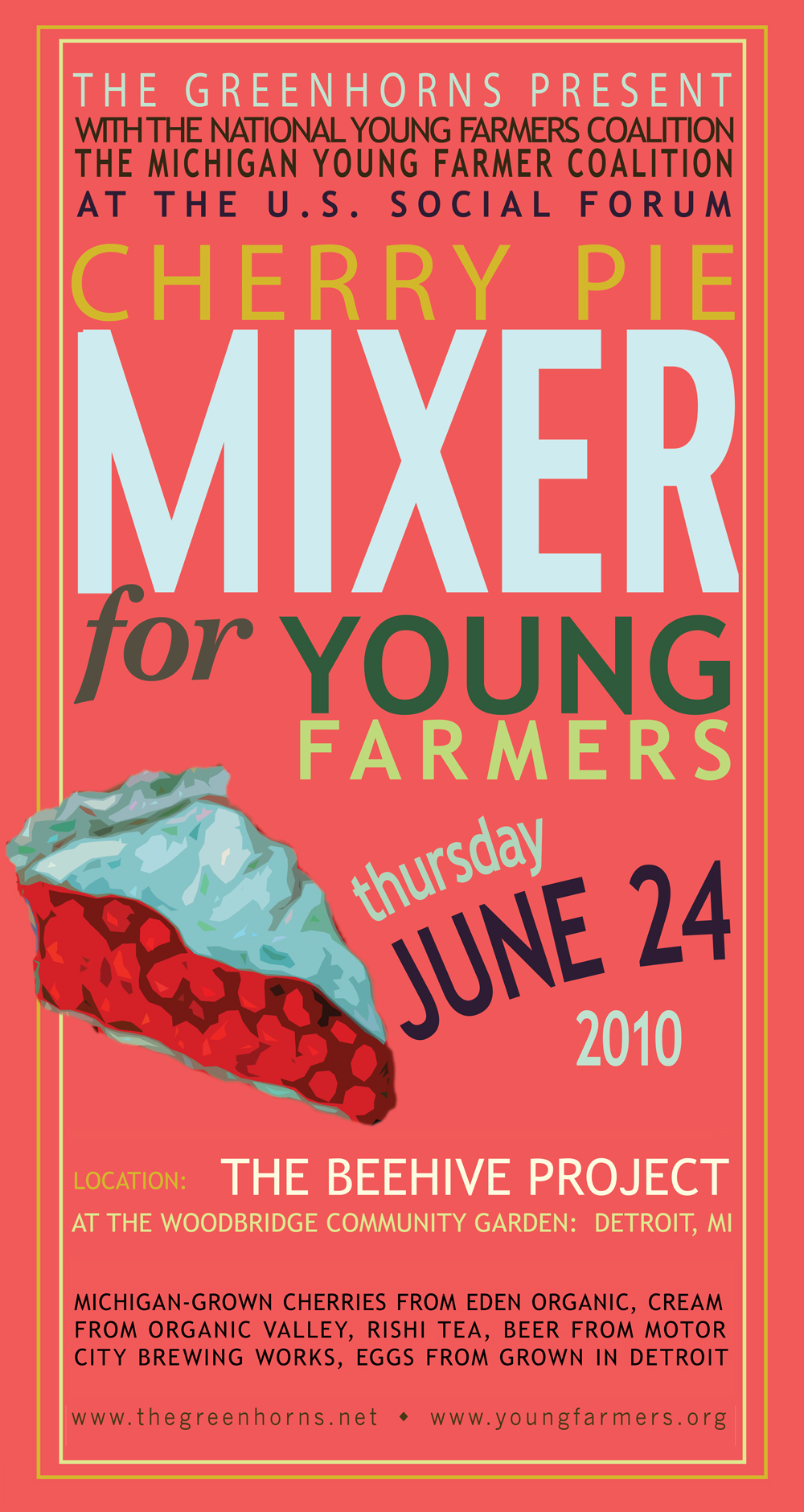
Flyer for the Cherry Pie Mixer.

Not completely garden-ed out for the day, we headed to the Young Farmer Cherry Pie Mixer organized by the Greenhorns at the Woodbridge Community Garden. And boy, was there cherry pie! So we mixed and mingled, pie in hand, with other young farmers and farm supporters, from Michigan and Missouri and Maine and California. I talked with one man who was in the mead-making business and thus decided to start harvesting his own honey, setting up hives across the city of Detroit. Before long, we were gathered together via bullhorn and given an introduction by Severine von Tscharner Fleming, documentarian and Greenhorn. Then Reverend Billy from the Church of Stop Shopping shouted us some proclamations about the revival of small agriculture in the face of overwhelming empire. Shortly thereafter, a keg of Motor City Brewing Works finest Ghettoblaster ale was tapped inside the up-and-coming art project of the Beehive Project, a “large-scale installation by an interdisciplinary community of artists and thinkers in Detroit” – not to be confused with the Beehive Collective, also awesome.

Reverend Billy preaching in front of the Beehive.

Tired and to bed.

Day Twelve:

BikeIt: Pedal to the USSF – Testimonials and Exploration of the Bicycle as a Tool for Social and Environmental Justice.

Welcome to the last day of thinking – for a while. Being a promoter of pedal-powered transit (even while in a skirt, transporting garden tools), I decided to buckle down with some bike riders. Two main bike contingencies shared their stories about biking to the US Social Forum. One from Ithaca, NY – covering 500 miles in 8 days. The other from Madison, WI – covering 300 miles in 8 days. Coordinated through the Bike-It Project, organized to promote biking alternatives and push both physical and mental limits. Each of the groups were followed by support vehicles – including the Permaculture Bus from Montana. Each made stops in communities to volunteer and build community within the collective through skill shares. Ages of bikers ranged from 9 to mid-70s. Bike collectives represented: Spoke ‘N Heart Collective (Atlanta), the Garlic Derailleurs (Chicago), the Grassroots Caravan (Madison) and the Petrol-free Gypsy Carnival Tour.

Saddle bag for bike made from refashioned kitty litter boxes - workshops lead by Petrol-free Gypsies.

Beyond sharing stories, we collectively identified issues and inhibitors of bicycles as the main form of transportation – as well as populations typically marginalized from biking communities. And brainstormed ways of making biking accessible to all, while building community and sharing skills while delving into the deeper topics of race and privilege. This is the beauty of the bike. To pass through new places and ponder the people and their stories.

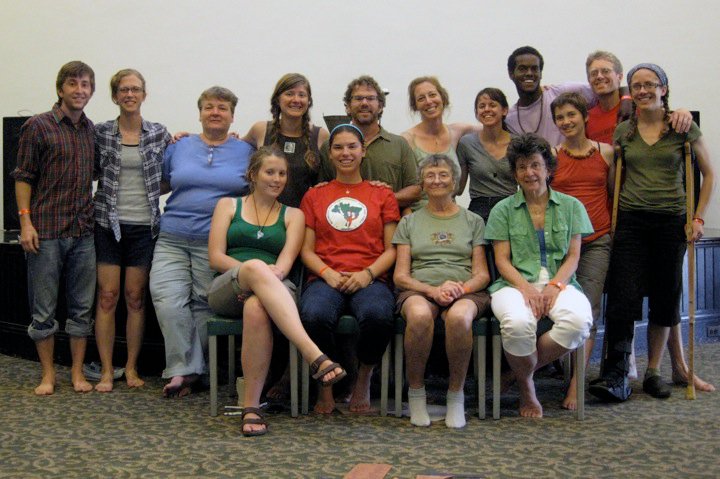
We Agrarians gathered together for the rest of the afternoon to process yet we had learned – and what to do with all that stuff once we got back to our places of origin. This was also our farewell. Might I add that a number of our Road Trippers will be returning home to plant gardens and wear more plaid.

Road Tripper group photo on our last evening together.

Day Thirteen:

Already some of our group had disbanded before breakfast. The rest of us headed to Detroit’s famed Eastern Market for some good eats before hitting the road (watch the video of our trek through the Market). The Eastern Market has been in existence since 1891 – and currently is a common source for groceries for a number of residents in Detroit. While there are a fair share of resellers (all those “farmers” who sell produce with stickers on them), there were a plethora of local bakers, urban farmers, and cheese makers. Even a few Amish farmers who start their trek to Detroit at 2am every Saturday. I also located my honey man and bought a jar of his Wild Detroit Honey.

Getting a wee bit road weary at the Eastern Market.

Then we started on our road home. Or at least to Louisville. And that’s where my story ends.

Ready to hit the road for home.

End Day Thirteen. End Part Six.

Friday, July 2, 2010

Agrarian Road Trip: Part Five.
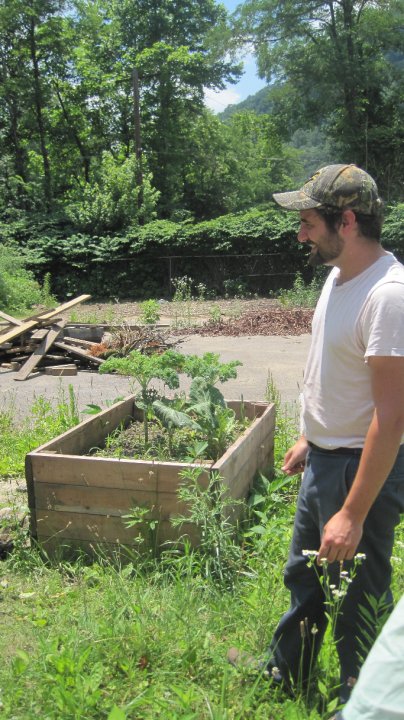
Joe Louis welcomes the Agrarian Road Trippers to Detroit.

No Jobs, Bad Transit, Good Gardens:

the Agrarian Tour through Detroit

Finally arriving in our destination, we – Agrarian Road Trippers – jumped head first into Detroit’s urban agriculture scene to hob-knob with some agrarian minded folks in Detroit – the folks who will remain to keep on fightin’ the good fight, even after the Social Forum vacates the city.

Day Nine:

Upon arriving in Detroit, we ate lunch with folks engaged in the US Working Group on the Food Crisis, a collection of people assembled to reinvigorate local food systems, craft new policy, monitor faulty policies, and represent the voices of growers across the country. Then we settled into our living accommodations at Fort Street Presbyterian in downtown Detroit before heading out for a tour with Lindsay Turpin from the Greening of Detroit.

Lindsday from Greening of Detroit leading us on a garden tour.

Lindsay works for the Greening of Detroit’s Garden Resource Program, helping start and support neighborhood and community gardens across Detroit. Detroit is sectioned into eight clusters, with each cluster containing one garden leader who communicates the resource and technical needs of each of the gardens inside that particular cluster. Right now, the Garden Resource Program oversees over 1200 gardens in Detroit.

Lovely lettuce.

Detroit’s had her fair share of bad news: high crime, high poverty, no jobs, bad transportation. However, a growing movement in the city is drawing the attention of outsiders. Urban agriculture in the city of Detroit is thriving. No the flip side, access to fresh food is a great concern – as there are no retail food chains inside the Detroit city limits. Large chains refuse to move into the city, stating that the demographics of consumers in city limits are not economically viable. Not to mention Detroit’s population is on the decline.

Such an environment has left Detroit residents no choice but to leave – or take up a shovel. With the help of the Greening of Detroit, folks are now gardening in full force, as well as learning how to keep bees and can and preserve their harvest. Greening has also started a youth employment program, called the Green Corps, to train youth in urban agriculture and urban forestry as well as teaching valuable job skills. Since 1998, over 500 youth have been employed through the Green Corps program.

Grown in Detroit - the documentary about Catherine Ferguson Academy.

One of the sites that we visited on our tour with Lindsay was Catherine Ferguson Academy – a high school for pregnant teens and teenage gals with children. The school has horses, chickens, bees, a mature fruit tree orchard, and over two acres in vegetable production. In addition to managing the livestock and tending the vegetables, the girls oversee a nursery and hoop house production to distribute plants to gardens throughout the city. Right now there are approximately 300 girls attending Catherine Ferguson – and all are allowed to bring their children to school for daycare services. Recently a documentary called Grown in Detroit was released, telling the story of Catherine Ferguson Academy.

I should also mention that it is against city code to keep livestock in the city of Detroit.

However, policies do not keep the Greening of Detroit from help more and more people grow and tend their own food sources. Partnerships are the background of the organization. The city helps with access to land – providing one year permits – while other land trust organizations with help community members buy the land over time. Greening is also fortunate to partner with Michigan State University’s Agriculture Department, so that a number of students complete their Ag Practicum in Detroit. Strong, diverse partnerships help Greening obtain funding from a number of sources: Kellogg and Kresge Foundations, MI AmeriCorps and AmeriCorps*VISTA, and Workforce Development.

As far as the problem with keeping livestock, Lindsay says that you need to make sure you have good relations with your neighbors. Give them some vegetables. Agrarians in Detroit aren’t just farmers – they are organizers. Recently Greening has received some requests to help with marijuana – but that’s an area Greening chooses not to go.

Recycled tire art at D-Town Farms.

Our next stop was D-Town Farms, a garden operated by the Detroit Black Community Food Security Network. D-town is a 2-acre plot, growing vegetables as well as operating a city tree nursery, bees, berries and mushrooms. In addition to in-ground growing, D-town has a number of tire container planters. Farmers at D-Town sell at the Eastern Market on Saturdays, as well as help facilitate a market cooperative called Grown in Detroit (not to be confused with the documentary), helping small growers into market growing.

Broadmoor Community Gardens.

Brightmoor Community Gardens was our final garden stop for the day. Brightmoor is the exemplifies urban plight in Detroit: a crazy cycle of high rent without security deposit keeps renters on their seats until they lose their jobs and evicted. As soon as the house is vacated, the house is stripped – of plumbing and wiring – left an abandoned shell, useless as a habitation. The costs to fix up the house now outweigh its overall value. So the house sits vacant. Unless a nearby gang is hosting an initiation – which frequently results in the burning down of vacant houses. In the midst of the craziness, there grows garden – or two or three or four.

Riet's backyard garden/farm and greenhouse.

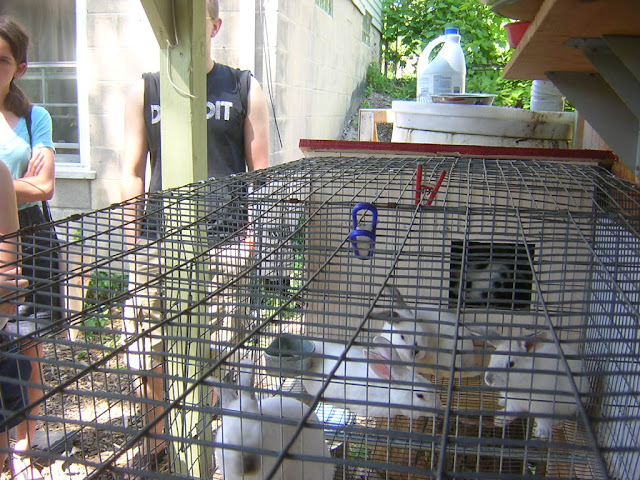
Brightmoor Community Gardens are headed by Riet Schumack, cluster leader for the area. She supervises the 22 kids who maintain the gardens, mow the grounds, paint garden murals, and plant fruit trees in the Brightmoor neighborhood of Detroit. The kids are under the understanding that working in the gardens is not a job – it is a profit-sharing venture, the more work each kid puts into the garden, the more money s/he will take home from market. Riet works with kids ages 9-18, increasing her ranks from 12 kids in 2007 up to the 22 she has now. Last year they produced 1,300 pounds of food from their collective gardens – which is distributed to the neighborhood families, as well as sold at Eastern Market and to a variety of area restaurants. In addition to helping neighborhood youth, Riet oversees her own backyard farm-stead, tending a garden and greenhouse and keeping bees for honey, chickens for eggs, and rabbits for meat.

Riet's rabbits.

With a crash course on urban agriculture in Detroit under our belts, we head back downtown for the March to the US Social Forum and Opening Ceremony. Then an evening of preparing for our workshop the next morning.

End Day Nine. End Part Five.

Agrarian Road Trip: Part Four.

At Gather Round Gardens. Note: Billboard - from radioactivity to peace.

Changing Diapers – or the Politics of Urban Agriculture:

the Agrarian Tour through Ohio

In the Ohio chapter of our travels, we – Agrarian Road Trippers – transitioned from the rural to the urban visiting and trading stories with many agrarian minded folks growing goodness in Ohio.

Day Seven:

From the winding roads of West Virginia we traveled to northeast Ohio. We pulled our caravan into a greenhouse nursery and mail-order seed distributor turned church, called Common Ground Church Community located in North Lima, OH. We unpacked our belongings then settled into the sanctuary for an evening of agrarian theology and sing-a-long song sharing.

Three Sisters Garden.

First things first. Greg Bowman, formerly of the Rodale Institute, shared with us what I will call the Theology of the Three Sisters. The Three Sisters growing method (milpa) originated in the Andes and in scattered indigenous communities throughout the Americas. The Three Sisters are corn, beans and squash – related because of their beneficial interactions providing a natural habitat for little critters and a complementary nutrient give-and-take with the soil. Corn provides a trellis for vining beans to climb, as well as protection from the sun for smaller plants and animals. Beans fix nitrogen from the air (complementing the heavy nitrogen-feeder corn). Squash sprawls the ground acting as a living mulch for water retention and weed suppression. Now compare this to a mono-cropped field of corn – exposed soil, neat rows, minimal water retention, nutrient depletion.

How does this all relate to theology? Just like the Three Sisters, we work/live/pray better together than as individual people. The mouth needs a hand to eat, like the corn needs the nitrogen fixed by the beans. As we grow food and appreciate the complex relationship between soil and sun, fruit and flower, a spirit of gratitude is cultivated within us. In our fast-paced, fast food society, we are a people in search of gratification, often lacking in gratitude for the complexity and beauty of life and food.

Where have all the flowers gone? To Cleveland.

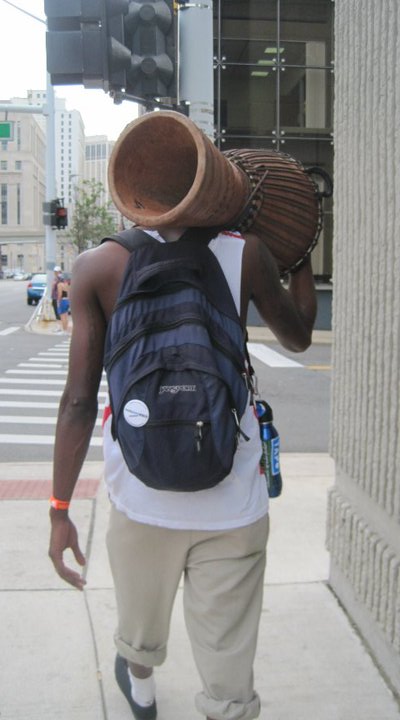
After a complex discussion about agriculture and theology, we needed a good sing-a-long. Guitars were plucked up from their cases. Congos and djembes pulled out from their nooks and crannies. And so commenced our own versions of Country Roads and Where Have All the Flowers Gone? Our music leader specialized in James Taylor – so, as you may well be able to tell, our song list was confined to hippie-era music.

Day Eight:

Aerial view of the Goodness Grows Farm.

The next morning – a Sunday – we woke to wonderful hospitality and a continental breakfast provided by the folks of Common Ground Church Community, followed by a tour of their partner program, Goodness Grows. Pastor Steve Fortenberry stressed his strong belief in the church as a multi-purpose site, to partner with other community groups and people. Seeing as CGCC is located in an old seed shop and greenhouse, these folks saw it fit to start growing gardens – now expanded to 1-acre in vegetable production. The week of our visit Goodness Grows was starting its own Community Supported Agriculture (CSA) for 15 families. Goodness Grows has only one staff member and a rotating schedule of college interns to maintain the gardens. Volunteers are another main source of labor, coming from the church, as well as a special needs class and GED program in the community. Another special resource for the farm is access to all the horse bedding and manure from the county fair – the largest in the state of Ohio. Future plans include refurbishing the many greenhouses on site for extended season growing as well as aquaculture for heat and fish production, similar to Growing Power in Milwaukee, WI.

Greenhouse seedlings at Goodness Grows.

After worship, we had another round table discussion with Pastor Steve, politically-connected Greg Harget from OH Governor Ted Strickland’s office, and prophetic farmer Maurice Small. Greg Harget Ohio Department of Agriculture but now works with Governor Strickland’s Faith-based and Community Initiatives Program in Ohio, which facilitates the state’s summer feeding programs as well as re-entry programs to strengthen the family. Maurice Small, on the other hand, works outside of the conventional systems of institutional agriculture and government. Maurice Small started a Cleveland-based organization called City Fresh, expanding access to food through urban agriculture. Because of the success of City Fresh in Cleveland, Maurice was invited to Youngstown, OH to help invigorate new growing initiatives.

Itching to get outside, Maurice sped up our conversation and we caravan-ed into Youngstown. We jump out of the van and are greeted with Maurice’s first question: “What is the murder rate of the place you live? This is important. You don’t know it, you don’t know your people.”

Maurice - telling it like it is.

Background on Youngstown: Former steel town. 80,000 people. 20,000 vacant lots. Worst school system in Ohio. Enter Maurice Small, urban gardening pioneer. Maurice’s mission is to reclaim vacant lots – lots where abandoned houses have been torn down or are still standing – and using reclaimed windows and boards from those houses and buildings, build raised garden beds. The first block Maurice walks us through has 10 houses – only two of which have residents. This is a ghost town. Maurice shows us the foundation of a house, crumbling and exposed – left vacant for 20-some years. Beyond repair. “They left [this city, these houses] . . . to my imagination.” Let me repeat that one more time: “They left this city . . . to my imagination.” Awesome.

Maurice explaining what he'll reclaim from this house to build a garden.

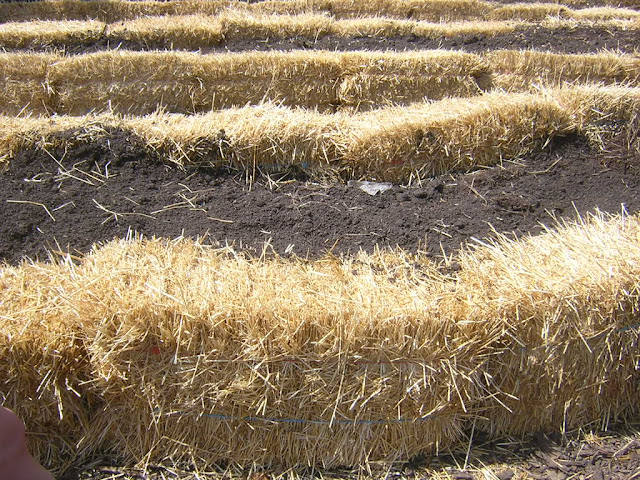
And his imagination envisions life and food, bountiful as the Garden of Eden. In addition to using reclaimed materials, Maurice builds raised beds from straw bales, with composted horse manure as his soil The straw bales are great for two reasons: 1. As the straw bales break down, they become organic matter to enrich the soil, and 2. Straw bales provide a sitting area directly in the garden. Maurice purchases the bales from a local farmer for $2.75, has horse manure donated from the county fair, and receives woodchip mulch and water from the city for free. He plants perennials and fruit trees and envisions the neighborhood children grabbing an apple on the way to school. He envisions neighborhood farm markets on garden property, where eater and grower get to know one another.

Straw bale beds - with composted horse manure soil.

Besides building gardens, Maurice is all about building community. While Maurice’s visions are beautiful and inviting, he is adamant that people do not flock to the places romanticized for their poverty or their potential. No gentrification. White people stay out. Help where you are from. This must be an indigenous revolution. The community must do for themselves. Then integrate slowly. Although Maurice is from Cleveland, he has been invited into Youngstown to help. Maurice has $400,000 over the next three years to jump start the gardens. He hopes to be out as soon as possible and let neighbors take the initiative to keep growing. Pointing to his toddling son, “I’m just here to change their diapers – then get out. Set ‘em on their way.”

Maurice Small - the prophet of Youngstown, aka the Jamacain Farmer.

With heads still whirling from the wisdom of prophet and poet Maurice, we jumped in the vans and headed towards Cleveland to dine with and tour the gardens of some folks involved in an entrepreneurial market garden program in and around Cleveland’s EcoVillage.

Market Gardens in Cleveland's Eco-Village.

Day Nine:

After a much needed deep sleep, we took to the road again to explore the urban agriculture scene in Cleveland – as led by Maurice. We Road Trippers continually made comments about Maurice’s incredible ability to identify every pocket garden and food project around the city – indicating some extremely detailed mental map of urban agriculture craziness inside his head.

Garden craziness at Gather Round Garden.

Our first stop, Gather Round Garden. Planted on top of a parking lot of an old convenience/liquor store transformed into a childcare center. Lots of amoeba-shaped raised garden beds in every shape and form. Bantam chickens and roosters cluck out of their coop refashioned from old windows and boards. Food goes to a store-front shelter and soup kitchen organized by a Catholic Worker House – as well as being distributed throughout the neighborhood. Worked out a lease with the landowner for $1. Been growing for 4 ½ years.

Gate to Kentucky Gardens, Cleveland, OH.

Second stop: the Kentucky Gardens. Been around for over 50 years. Less than one acre. 200 families. Community greenhouse. Plots are rented out by the summer growing season – $10/large bed, $5/small plot. Each gardener is required to contribute so many hours of service to the maintenance and upkeep of the property each year. Has a fruit orchard and beehives. Here we met Maurice’s mother.

Back alley garden for chef of Marigold Catering.

Third stop(s): two chefs. Chef one – growing in an alleyway betwixt two very large buildings. Marigold Catering. Herbs, edible flowers, vegetables, and mushroom logs. Chef Two – Chef Karen Small of the Flying Fig. With the help of youth recruited and trained by Maurice, built raised beds in her backyard. Grows herbs, vegetables, and watercress (in a simple outdoor aquaculture system) for use in her restaurant based around local foods. Here our fingers – and lips – became stained with the purple blood of mulberries, as we avidly harvested backyard berries at Karen’s invitation.

Road Trippers picking mulberries in Chef Karen's backyard.

Fourth stop: Vel’s Purple Oasis. Started in 2008 by a grandmother and her granddaughter Kayla. Bought land 20 years ago with the dream of someday having a garden. Named after Vel’s love of the color purple – which represents majestic royalty. The garden is an oasis in the midst of Cleveland’s death and drought. Rebuilding the soil by solarizing the weeds, laying down cardboard and sickle-cutting hay to build lasagna garden beds. Built a strawbale greenhouse with the help of Brad Massey at the New Agrarian Center in Oberlin. Recently bought some nearby house to open as a community kitchen and place of holistic healing.

Farmer Kayla tours us through the herb spiral at Vel's Purple Oasis.

We were unable to visit the New Agrarian Center in Oberlin, OH, due to the craziness of our schedule and the wealth of information already clogging our noggins. So we went to the West Side Market (Cleveland’s year-round indoor market) or falafels. That evening we enjoy a sunset – and the Summer Solstice – on Lake Erie.

the Summer Solistice on Lake Erie.

My closing thoughts:

“To everything, there is a season, and a time to every purpose under the heaven: a time to be born and a time to die, a time to plant and a time to pluck up that which is planted, a time to kill and a time to be healed.”

- Ecclesiastes 3:1-3

End Day Nine. End Part Four.

Agrarian Road Trip: Part Three.

Coal Country, West Virginia.

Take Me Home, (Coal) Country Roads:

the Agrarian Tour through West Virginia

One of the unofficial theme songs for us – Agrarian Road Trippers – has been John Denver’s “Country Roads” – mainly because of the line “West Virginia. Mountain Mama. Take me home. Country Roads.” And West Virginia – or at least the southwest region – has her fair share of country roads. It is in the midst of these country roads that we have visited and shared stories – as well as a few bluegrass tunes, picked out on banjo and guitar – with fellow agrarian minded folks in Coal Country, West Virginia.

Day Six and Day Seven:

Mullens Community Garden at RAIL.

Our main contact in Mullens, West Virginia, is the organization Rural Appalachian Improvement League (RAIL), where we hook up with fellow young agrarians Jack and Becky. Jack has been working with RAIL since 2008. Originally from West Virginia, Jack was hired to start a farmers market in Mullens – only problem being there were no farmers. This is coal country. No one farms here. In order to tell his story of the work he has done with RAIL, Jack first had to share the story of coal in Mullens and her surrounding coal camps.

the Locals.

First off, there aren’t towns. There are coal camps – little “villages” created by the coal companies to house miners. These houses were built precariously upon steep mountain hillsides, with little space betwixt neighboring houses – seldom a yard or septic tank. Today, 65% of all sewage in Wyoming county is directly pumped into the river running through the camps. This is not to mention the additional run-off dumped by the coal industry. This is the water – should agriculture gain momentum – that will be used to irrigate gardens and livestock. In 2001, Mullens suffered a drastic flood, water climbing to ceilings on the first floor story of buildings and homes throughout the town. Although a flood to this magnitude is not common, seasonal flooding happens on a regular basis. For the beginning agrarian, having your garden washed away at least once per season is quite the discouraging start.

Farmer Jack at the Mullens Community Gardens.

However, Jack sees gardening as one step towards self-sufficiency for the people living in communities historically tied to the coal industry. In former times, the coal companies outlawed gardening in coal camps – thus making coal miners and their families dependent on purchasing food from the mercantile stores operated by the coal companies. Although growing gardens is no longer illegal, the coal companies still own 85% of the land in Wyoming county where Mullens is seated. Another 5% of the land is owned by state and federal government – leaving a mere 10% of land available to the people for housing, parks, gardens and businesses.

Visting a neighboring gardener and his horse Hank.

Coal is in the blood of the people,” one local woman from the organization, Friends of Milam Creek, told us. Out of the 20,000 people in Wyoming County, only 800 are employed in the coal industry. Employment in coal has drastically decrease with the rise in mechanization of the industry. Although most people living in coal country know at least one person who has died of black lung, jobs in the coal industry are the most sought-after. A coal miner with a high school education can make more money in a year than a college professor with a PhD. The balance of health-versus-wealth is a thin line to walk in the coal industry. Jobs for the remaining individuals span mechanical labor, food service and retail. Many area youth drift away from their communities when – and if – the opportunity arises.

Note: bumper sticker.

With all these thoughts muddling up my mind, we head out to the RAIL Community Garden – to mull over thoughts and pull some weeds. In addition to locating spaces for community residents to “farm” – there is a stigma attached to the lesser work of gardening – RAIL provides workshops on growing food, canning and preserving, and hosts a farmers market on RAIL’s property. Fresh food is grown for sale at market, for donation to food pantries, and for family consumption of those who grow it. We visited a few more gardens before harvesting some vegetables for our own dinner. At our last stop I noticed two bumper stickers both at the same house: “Nader/Gonzalez” and “I ‘heart’ Coal” – an interesting combination rarely replicated in any other community.

Note: political sign.

It doesn’t take an agrarian-minded person to connect the story of coal country economics in Appalachia to mechanized, mono-cropped agriculture in the Midwest. (The average age of a farmer in America today is 57.) Disillusioned youth are encouraged to seek educational opportunities elsewhere due to the lack of vocational attachment to the industry of the area. To leave is to succeed. Rarely applauded or honored are those who choose to stay. To mine. To farm. Outside do-gooders with liberal arts educations grounded in service to community are heralded by their own communities as heroes. But those who choose to stay are seen as having missed their golden opportunity.

West Virginia, Mountain Mama. Country roads, take me home.

End Day Seven. End Part Three.

Thursday, February 5, 2009

Alumni Returns to Waco

Here is a post from the Baylor Website about a WHRI alum.


Jeremy Everett Named To Direct Texas Hunger Initiative At Baylor School Of Social Work
Feb. 4, 2009

Contact: Vicki Kabat, Baylor University School of Social Work, (254) 710-4417

Jeremy Everett will join Baylor University's Center for Family and Community Ministries (CFCM) in February to direct the Texas Hunger Initiative, a new project to alleviate hunger in the state that is being sponsored jointly by CFCM and the Christian Life Commission.

"With some organization and creativity, hunger in Texas can be alleviated, and I think we'll be well on our way to that within six years," said Everett, who earned his undergraduate degree in religion and history from Samford University and his master's of divinity degree in 2001 from Baylor's George W. Truett Theological Seminary.

The THI project comes alongside hunger ministries related to the Texas Baptist Offering for World Hunger through the Baptist General Convention of Texas, which currently provides $475,000 for 95 Texas hunger ministries. The initiative will build capacity of existing ministries that are addressing hunger in the state. Initially, the project will identify regional leaders in the state and create networks, meeting the different needs of each region.

"I appreciate that this project begins by assessing strengths, and then allows us to build upon those strengths with a model that incorporates cultural and environmental sensitivity," Everett said. "We already have a lot of great efforts to alleviate hunger in place."

Suzii Paynter, director of the BGCT's Christian Life Commission, is excited about partnering with the Baylor School of Social Work. "It's like a new harvest to have the Baylor School of Social Work as a partner to boost and nourish the network of Texas Hunger Offering ministries," Paynter said. "Great people are doing God's work caring for the 'least of these,' and this project will give them tools, support and blessing for ever greater things, especially as we focus on Texas HOPE 2010."

Everett has spent the past five years in San Antonio's West Side, a historically low-income area where he lived with his wife, Amy (MDiv/MSW, 2004) and their two children, Lucas, 4, and Sam, 2. Employed by Baptist Children and Family Services, Everett helped start Guadalupe Street Coffee, a café with computers, wireless Internet service, murals painted by local artists and meeting spaces. As a community developer in West Side, Everett worked to bring together members of the City Council, business owners, and students and administrators from the area's Sidney Lanier High School.

The coffeehouse employs an average of seven people and sponsors a variety of youth and community programs, including college assistance, art events and business development meetings. Now, $2 million in city and federal grants are slated to further economic development in and around the coffeehouse, according to an article by Abe Levy in the Jan. 24 San Antonio Express-News.

The Texas Hunger Initiative will give Everett opportunities to use his community development skills on a broader scale. Initially THI will focus on El Paso, the Valley, and Bexar and McLennan counties, seeking to develop and implement strategies to alleviate hunger through policy, education, community organizing and community development.

"We have chosen to focus on these areas first because there are existing programs and relationships," Everett said. "We can build upon the trust that is already there and grow successful partnerships."

Everett will spend the first months in his new role getting to know dedicated people who address the needs of the hungry every day and involving social work graduate students in the initiative.

"The process we'll put together for the hunger initiative is the same one I used in San Antonio, and both use social work principles," he said. "Students interested in community development and community organizing will graduate from the Baylor School of Social Work with direct practice experience gained through this initiative."

Baylor's School of Social Work began a concentration in community development this past year, and students already have been effective in a specific community building effort to alleviate hunger. The fall 2008 practice class researched, organized, chartered and began a Campus Kitchen, based on the national program in Washington, D.C. Now a part of Baylor's Student Life Division, the kitchen will retrieve unused, quality food from campus dining providers, local restaurants and grocery stores, and feed nonprofit groups and to local service agencies this spring.

In addition, the CFCM has researched and written original curriculum titled "Understanding Poverty," that now is being tested in congregations before final publication.

"We have found that churches are nearly begging for resources to help them address community needs," said Dr. Jon Singletary, CFCM and assistant professor at Baylor's School of Social Work. "We will continue to develop a curriculum on poverty to present to churches and civic groups as a way to introduce and prepare them to engage impoverished families in their communities."

The initial three-year funding of $100,000 annually for the THI will come from grants, gifts and BGCT sources. Everett will be located at the CFCM in Baylor's School of Social Work.

"Feeding hungry people and developing communities so that families can afford to feed themselves - that's what Jesus called us to do," said Dr. Diana Garland, dean of the Baylor School of Social Work. "I am thrilled we will be working with the Christian Life Commission of the BGCT to help congregations bring an end to hunger and the poverty that creates hunger in their communities."